
DECOLONISING THE FUTURE
SO WE DON’T HAVE TO LIVE INSIDE ZUKERBERG’S DEATH PROJECT

DECOLONISING THE FUTURE
SO WE DON’T HAVE TO LIVE INSIDE ZUKERBERG’S DEATH PROJECT
Millions of worlds, billions of avatars, and trillions of stories are being born inside our new and coming universes: metaverses, video games, twin selves. BRiGHTBLACK’s latest project explores the REcolonisation of these spaces and how we can DEcolonise them using the very same technologies. Because COLONISATION IS A DEATH PROJECT.1
Here, we share our independent research on decolonising digital spaces, centre the relational knowledge and lived experience of our brilliant participants2 when we should be doing the actual evaluation form [see end of article].
THE PROJECT
CARNiVAL received £30,000 from Arts Council England. We worked with people of colour from marginalised genders from Brighton to Bradford in creative workshops to reflect on their stories and imagine a new world. We undertook:
1) a process of listening, exploring and debating new perceptions of justice, freedom and power that were also places for conversation over food and music, in-depth moments (we recorded), festivals of playful media (time to play)
2) a process of sharing and debating emerging digital skills (e.g. real-time engines for VR, AR, video games, avatar creation and animation, spatialised audio, live experiences etc.), their forms, politics and philosophies - and how they can be used for positive change
3) our creative process bringing this all together to create a living, playable experience and live performance for large audiences - weaving the expressions (images created in sessions), stories and conversations (recorded in sessions), movement (motion capture, animation from the sessions). Giving people of colour (from marginalised genders ) the space to imagine something new and then to experience it. A collective meditation on justice, freedom and power for us all.
BRiGHTBLACK crafted a sensory world in real-time engines using its functionalities in responsive, adaptive ways e.g. physics such as gravity, visuals such as lighting, fog, 3D modelling, animation, VFX, audio such as modular synths, game feel like camera shakes, live performance - e.g. using the energy and the moment to ‘play’ the camera movement, audio effects and samples.
THE SHITERNET IS BECAUSE OF COLONISATION.
COLONISATION
Here, we refer to settler colonialism - the migration of settlers to displace or eliminate indigenous people from lands for capital gain. An ongoing process of oppression for total appropriation3. A structure not an event.4
DIGITAL RECOLONISATION
The reproduction of knowledge and power systems for ongoing oppression, total appropriation for capital gain in digital lands. A structure, not an event.
DIGITAL DECOLONISATION
Is a process of de-linking ourselves from current knowledge and power systems in digital lands and creating new digital worlds.
How does colonisation take place?
1. ENCLOSURE
In colonisation, land is capital5, dispossessing existing inhabitants using violence or the threat of violence, enclosing the land through private property for capital accumulation6.
Q: Who is profiting? Where do those profits go?
1. DIGITAL RE-ENCLOSURE
A system originally named “Enquire Within Upon Everything,” by its inventor, Tim Berners-Lee - was meant to be an open, democratic landscape for the free sharing of information, a structure with the potential to connect our rapidly expanding species across the globe. Now known as the internet. Now: “five giant websites, each filled with screenshots of the other four.”
Imagine what years of floating in the infinite imagination soup that could have been our digital lands could have done for our stiff shoulders and scattered minds. At least we have the clouds - well, ‘cloud capital’ (says Yanis Varoufakis). This is the centralised structure those five giants have built on top of our networked, globalised system of connectedness. A system of enclosed lands and laws that:
Trains us to train it to show us what we “want”
Sells us what we “want” (there is no marketplace)
To get more of what we “want”, we feed it our data, reviews, ratings etc
Businesses too are enclosed, dependent on Big Tech algorithms and passing around 40% of their sales price to the new digital ‘land owners’. Amazon for example made $55 billion in sales in Europe and paid ZERO tax.
This is not capitalism, it is ‘Technofeudalism’7.
Also known as the enshittificaiton of the internet.
We find ourselves in a series of grey meeting rooms - fronted by brown women in head coverings [see Meta’s Horizon Workrooms] - the prevalence of grey can only be matched by ‘The Road’, if you’ve ever read that. We find ourselves in real-time, walled from perceiving by torrents of images and slogans, breeding in us a post-lexia8, robbing us of the space to remember and make new thoughts. Dispossessing us from ourselves, each other, the horizon.
We find our new networks, once crackling outposts of alternative thinking and discussion (early internet) are inter-passive like-minds9 (feudal internet) - for example, why was I so struck by a woman of colour saying that interrogating language and naming would lead to policing of language and naming (stuck in my bubble). Valid point but I couldn’t let it go…
2. POSSESSION
Asserting control through ownership
E.g. through language and naming. ‘Appannah’ is my surname and the surname my great, great grandfather was given. Stripped of his identity, he disembarked the ship in Port Louis, Mauritius to join thousands of others who were deceived into replacing sugar plantation slaves for almost-zero wages and conditions, now they were named ‘indentured labourers.’
2. DIGITAL REPOSSESSION
Zukerberg stole the name Metaverse (from the novel Snowcrash by Neal Stephenson) and renamed our new digital lands with it. When it is a boundless space. When it is already living communities of redditors, gamers, YouTube philosophers etc.
Q: Who is doing the naming? What are they doing it for?
“I found the name while weeding… the plants seed themselves far from their parent plants. Even they don’t sit in one place and wait to be wiped out… Earthseed… I am Earthseed… Anyone can be. Someday, I think there will be a lot of us. And I think we’ll have to seed ourselves farther and farther from this dying place.” - [Parable of the Sower, Octavia E. Butler]
3. ADMINISTRATION
Systems can get away with murder - very hard to punch Section 28 in the face. So with increasing complexity, colonial powers invent and embed executive systems to create and enforce laws that give power to settlers. E.g. the UK’s Illegal Migration Bill - create a law making people illegal, enforce it to justify enclosure in de-human detention centres. Ignore the UN warnings. Ramp up the propaganda when the UN turn out to be correct.
Q:Who does the law serve, who does it protect?
3. DIGITAL RE-ADMINISTRATION
Section 230 of the Communications Decency Act gives social media platforms stunning protections under American law. Also called the most important 26 words in tech: “No provider or user of an interactive computer service shall be treated as the publisher or speaker of any information provided by another information content provider.” Humans are allowed to be visitors to this legal universe, further defined by a system of self-governing laws (algorithms) to keep people enclosed. Big Tech lobbies the government to crush laws that put people over profit e.g. by building a wall of legal experts to protect profits from The UK’s Online Safety Bill.
*RECOLONISATION BETWEEN THE REAL + DIGITAL
Make up the NAME ‘Special Economic Zones’ to ENCLOSE real and digital lands. Use an ADMINISTRATIVE system of business and trade laws e.g. investor-state dispute settlement (ISDS) to allow billionaire crypto-bros to sue entire countries, as they did to Honduras, for half its GDP, when its government tried to protect citizens from the fallout of said Special Economic Zones.7
THE COLONISER’S MORNING AFFIRMATIONS
ABSTRACT (e.g. tree = wood))
EXPLOIT (e.g. humans =labour + buying power)
EXTRACT (e.g. strip assets, strip resources, strip identities)
ACCUSE (e.g. distract and deflect with blame)
WE KNOW WHAT WE ARE AGAINST. WHAT ARE WE FOR?
Here, we go back to centering our participants (women and marginalised genders of colour in Bradford, London and Brighton) to understand decolonisation, reflect, critique, and evaluate CARNiVAL. With my thoughts intertwined.
ENCLOSED > UNENCLOSED
In almost every single chat (interview) we did, where we asked for ONE thing people would change when imagining a new world, they expressed the desire for PHYSICAL/EXTERNAL SPACE. No agenda. No criteria for being there, that the space would feel like home [Lorna Hamilton-Browne MBE - Artist, Maker, Academic, Independent Researcher]. Rubina Khalid [Co-CEO of WomanZone in Bradford] referred to the village in Pakistan she grew up in - there were no walls, and someone had money and they all went to look at it, she said. People’s lives were changed by places like the Moonshot Centre (New Cross) and The Sanctuary (Brighton), WomanZone (Bradford) - people were moved to tears talking about the impact of giving and receiving care in these places, by the people they found there, by there being a light on in the dark. They were critical places to be yourself - Amber Gibbins, an artist in Brighton pointed out - especially when she was living in hostels and an absurd administrative system deemed her not homeless enough, forcing her out onto the street.
EMOTIONAL/INTERNAL SPACE. Witness others said Sense Turner - an international Creative Facilitator and Community Engagement Practitioner and artist. Sense expressed the desire as a young person to this day to be seen, heard and understood. Giving space for challenge, debates, tangential discussions and balancing the needs of the room by knowing what is in the room is vital. Sense pointed to her practice of welcoming what's in the room, understanding what people may have been through before they even sit down. We’ve all seen and some of us have been the person who wants to run away because they've been misunderstood so many times. It creates a storm. You wish to be swept away. You disconnect. You rebel. As Tahera Kacholia [Trustee of WomanZone] said, many communities lose connection when they come here, so it is even more important to include them. If they do share with you, believe them, said Zuzanna - writer, photographer, transracial adoptee - referring to when she worked as a nurse and as a prison officer. This stayed with me. It is the ultimate safety.
POSSESSED > UNPOSSESSED
“Don’t assume things about me” asserted Rajesh Appannah. People who have faced multiple barriers are powerful, creative beyond the arts school definition and they have strategies. When we took Rajesh* (my mum) and Sheila* Appadoo (my auntie) both Mauritian women and retired NHS nurses in their 70s along with a group to the motion capture studio at Canterbury Christ Church University, I asked them to imagine where they felt free. Suddenly we were on a beach with rum and coconut and another brilliant participant Prentice flowed into being (we didn’t name it role-play, we just let it happen).
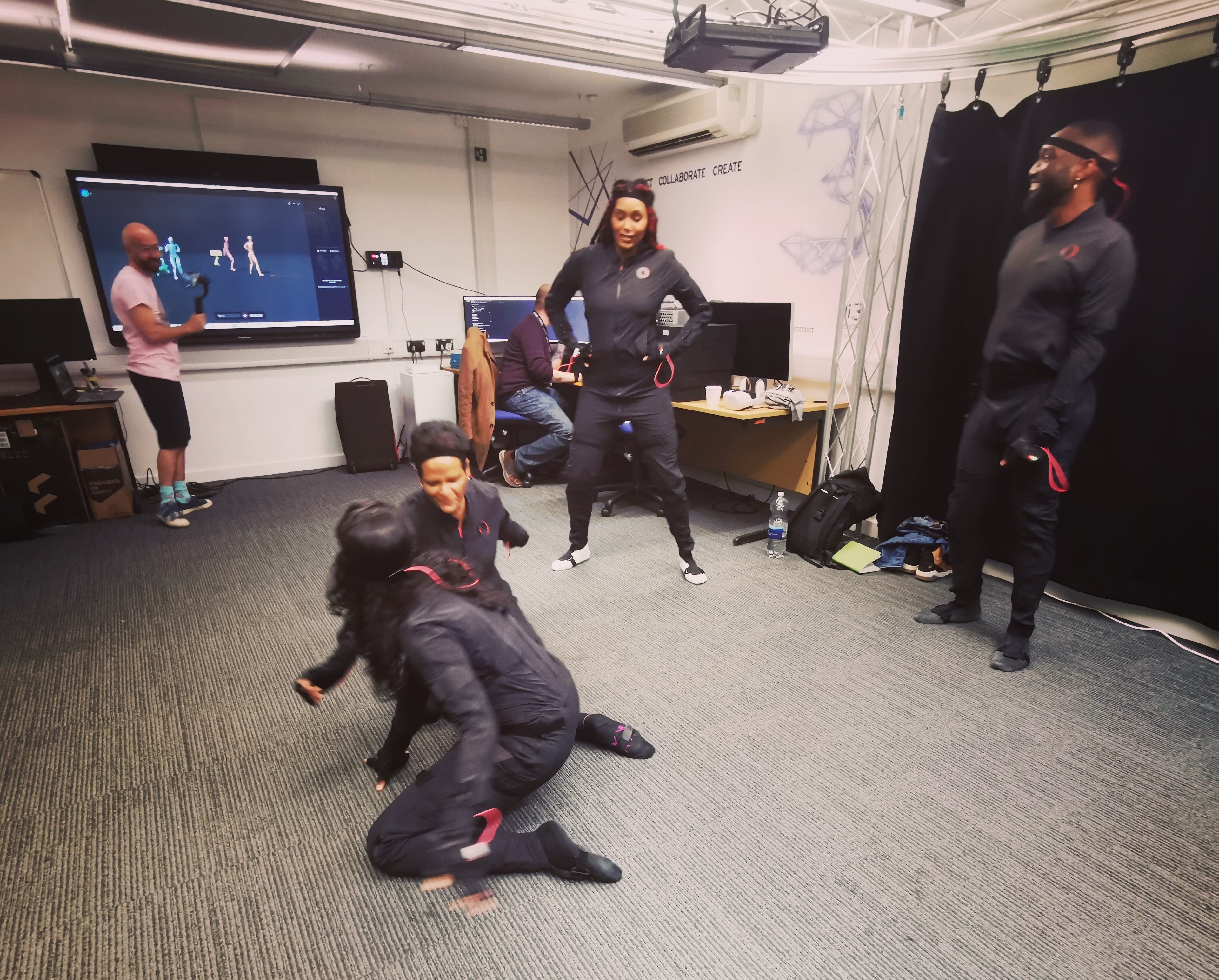
When we asked people to be themselves in the mocap suits (they could see their movement animating the basic avatars in front of them), we didn’t call it ‘dance’ or ‘movement’, we just played a playlist we had curated with them beforehand and turned it up loud on a speaker we bought along. The main challenge was getting folks to stand still long enough to get the tracking right: too many tunes. The energy gave way to intimate conversations about why they felt comfortable and wider discussions about feeling at home and sharing their stories (which we were able to record with their permission).
*Ironically both adopted these first names to help British people with their pronunciations. Rajesh = Veejaiya Letchmee, Sheila = Amboojaveli.
Research and people, such as the white woman on multiple boards of big institutions, told us that ‘black people can’t play’.’ Q: Who’s asking who to do what?
ADMINISTERED > UNADMINISTERED
Lorna pointed to the frustration of project-based works. For change to happen, we need long-term funding support, invested mentors, black people to write their own applications so that white institutions come to black people instead of using them, she tells the young people she works with that “we can make our own table, like Stormzy.”
APPLY IT
CYCLE OF SELF-CRITIQUE [NOT TO BE DONE ALONE]
A process of imagining based on relational knowledge and lived experience
Unenclosed
> Have I got their permission? E.g if you’ve ever been tokenised by someone putting a camera in your face to show they’ve ticked their boxes, you’ll find a different way
> Have I set an agenda (even unconsciously)?
> Who have I invited into the space and how have I welcomed them in?
> What does the space feel like? Grey? Unsafe? Inflexible?
> Have I understood the needs of everyone in the room before they arrive?
> Have I thought about what happens to them when they leave?
> Am I creating space or taking space?
> What do I represent in the space?
> Is there time/space for people to connect with each other? And be alone?
Unpossessed
> What language am I using? E.g. is it alienating? Is it relatable? Inclusive?
> Am I using language flexibly to meet people’s different skill/experience levels?
> Have I allowed people to define themselves, set their own agenda, realise the process /outcomes they’ve set?
> Am I telling or showing?
> Am I allowing exploration and experimentation?
Unadministered
> Are there rules? How do they serve / antagonise / assist people?
> Are we asking people to behave in certain ways?
> Do resources help people meet their needs? E.g. self-learning
BRiGHTBLACK’s APPROACH
PRACTICE - we come from low-income poc/neurodiverse backgrounds and are self-taught in multiple areas from writing feature films to creating and performing electronic music and acting on stage to coding and making video games with real-time software. From a zero-budget DIY approach to working with big teams and budgets. We share our hard-won knowledge and at the same time we are open about our lucky breaks and the structures that enable us. We subvert roles and expectations - Myra does the tech demos and talks software, Simon talks psychology, live theatre (sometimes we miss doing the opposite roles but we’ll make the point until we don’t need to make it anymore).
PEOPLE - we have decades of diverse experiences from setting up the first neurodiversity film festival (Oska Bright in 2003 and still going), setting up and running playful media festivals for learning disabled, autistic and neuro-diverse people (Level 3). We have been running our Immersive StoryLab programme since 2013 - from drop-in sessions in the centre of Caracas, Venezuela overlooking the military airport in as military helicopters (and vultures) circled above to 8-week in-depth women and marginalised genders (with XR Stories), recreating lands from which people were forcibly removed as virtual places with sensory memories (Chagossian Elders in Crawley with Creative Crawley), to working with established writers, producers, directors with the Royal Shakespeare Company, Brisbane Powerhouse, Screen South/BBC Arts and more. So we were able to find a language to talk about metaverses and video games with mainly Urdu speaking women in Bradford who tended to be low-income mothers in the home, with the help of their children and our great translator Tahera.
FEEL - we endeavour to embody ease, access, an anti-expert, pro-experimentation stance. We have paid guest spots e.g. Zoyander (disabled, neuroqueer PhD artist and researcher in indie video games). This allows us to flex to participants’ needs.
- we drop bombs to shatter fear, cynicism, paralysis and nihilism, deadness and numbness towards hope, possibility and action e.g instead of “how do we tackle climate crisis” > “why are 70% of global warming deniers confident, white conservative males?”. Bombs are dropped with the intention of making things better rather than harming.
- we don’t shy away from difficult conversations and we speak in the language of freedom and power e.g. “if you are feeling fearful, it is worth thinking about how a technology is a paintbrush - a tool to extend our inner world outward. The difference now is DATA. And privacy is your human right.”
“My experience of BRIGHTBLACK'S workshops has been incredible. They are generous in creating a truly inclusive environment for poc people… Firstly, there are cutting edge tools and space, and delicious vegan food which is provided for free! Secondly, they go at your pace of wellness, and are really informative in showing you the possibilities…without any jargon. They brought a lovely intergenerational group of us together… Myra and Simon even provide the resources for training, equipment, research and signposting to start you on your journey. This has been life changing for me as a multidisciplinary artist who is in the process of developing and building my own social enterprise in this space. I am deeply inspired by their practice and their delivery. I would recommend it to everyone I know who is interested in game design and its potential for creativity and social change.”
- GRACE L [multidisciplinary artist]
FREE - we have developed our own resources from years of learning in practice and offer these for free, for ongoing learning. At the same time we engender an understanding that crediting us is important as it generates a sustainable future for us, allowing us to keep doing this work
- understanding needs, we provided free food and drink, allowed time flexibility, paid assistants, checked in with participants, credited and acknowledged them throughout, continue the conversation, continue to support learning and ongoing work where possible
- we made the live event free and we treated our contributors - free drinks at the bar and paid for accommodation for anyone visiting from another city who did not have the means.
TAKE OUT: untangle yourself from complexity and get out of your head by not forgetting what you already know - being with people, sharing food and music
END?
Our new and coming worlds will be the tectonic shifts in the who-are-we / who-will-we-be? stakes. If we do not begin the process of decolonising, our minds will continue to be split by addictive-design technologies, our power and freedoms will continue to be stripped by the platforms that run our lives, elections will continue to be influenced using laws like Section 230 and this will have a direct impact on the climate.
For decolonisation to be possible, we must move from passively observing to meaningful participation in a process, in an unenclosed, unpossessed and unadministered way. And then a cycle of reflection and practice that centres relational knowledge and lived experience. In this way we can begin to imagine the new.
. . .
Understanding how settler colonialism works, that it continues in real spaces and is able to reproduce and dominate in our emergent, newly forming spaces, is to see that it is ‘a pervasive atmosphere’. One that gives us the feeling that it is easier to imagine the end of the world than its end (Capitalist Realism, Mark Fisher).
“Radical just means grasping at the root”
- Angela.Y Davis
So we must develop our own pervasive atmosphere. We must enter a process of becoming unenclosed, becoming unpossessed, becoming unadministered and unmediated. Our intentions and practices must actively seek and create complex understanding (not abstraction), nurture and sustainability (not exploitation and extraction), and take responsibility with rigorous structural analysis (not deflection, distraction and accusation).
This begins a cycle of perceiving ourselves and others, of BECOMING decolonised.
“Putting yourself in new situations constantly is the only way to ensure that you make your decisions unencumbered by the nature of habit, law, custom or prejudice – and it’s up to you to create the situations.” - Crimethinc
IN THIS WAY WE CAN BE FREE…
Q: When we are talking about gaining freedom, WHO are we talking about?
Q: When we are talking about freedom, freedom from WHAT?
Q: When we are talking about freedom, freedom to DO what?
[See ‘Freedom is a constant struggle’ - Angela. Y. Davis]
We need help to do this and without our networks and institutions supporting us, the work is left to us as individuals.
So now for the actual evaluation form, which in the colonised view, measures worthiness as empirical outcomes of a perfectly crafted project:
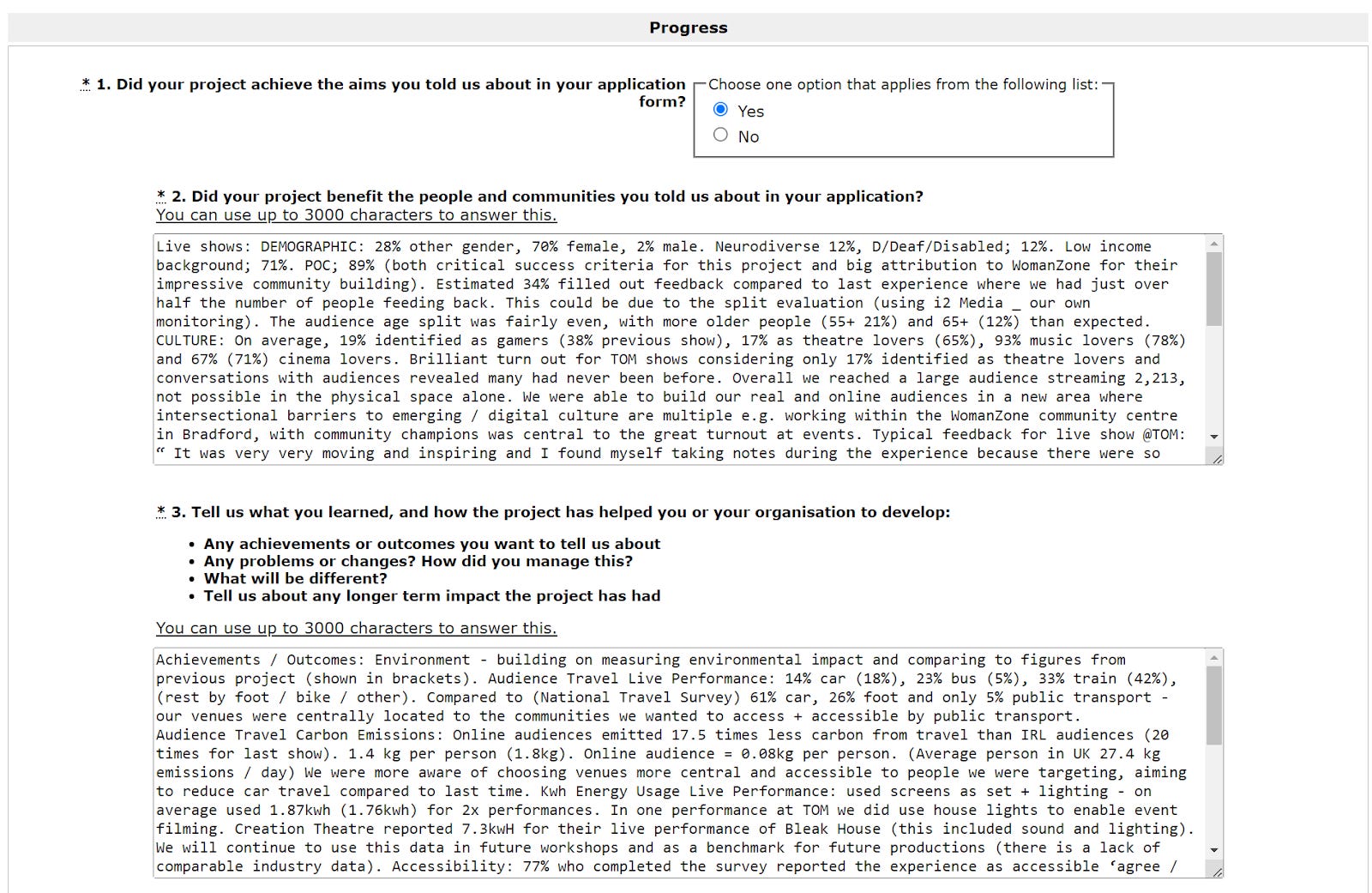
[EXTRACT FROM ARTS COUNCIL EVALUATION FORM]
MYRA APPANNAH
BRiGHTBLACK
INSTA: @BRIGHTBLACK_PRODUCTIONS
WWW: BRIGHT-BLACK.ORG
__
Myra Appannah and Simon Wilkinson created BRiGHTBLACK in 2019 to explore the radical potential of immersive technologies to create playable, interactive experiences that democratise, disrupt and decolonise our culture. Their works have been credited as amongst the most influential immersive productions of the last 20 years [UKRI] and they have been described as ‘one of the most notable names in VR [CINEUROPA Magazine]. They have toured to 36 countries on 5 continents featuring at venues including Tate Modern. They have run hundreds of labs, consultancies and commissions with universities and institutions such as The Royal Shakespeare Company, The British Council and Sydney Opera House and grassroots organisations, with the aim of creating a new paradigm for culture that gives power back to the individual and the community //
__
REFERENCES
1Omanga, “Decolonization, decoloniality, and the future.”
2 The challenges of decolonising participatory research in indigenous contexts: the Atautsikut community of practice experience in Nunavik. Lucie Nadeau, Dominique Gaulin, Janique Johnson-Lafleur, Carolane Levesque, and Sarah Fraser
3 What is settler colonialism? Shreya Shah [https://www.theindigenousfoundation.org/articles/what-is-settler-colonialism]
4 Settler Colonialism and the Transformation of Anthropology
5 Tyson Yunkaporta - on Pattern, Kinship, and Story in a World of Decontextualized Minds - The Emerald. 26.05.21.
6 https://www.youtube.com/@Andrewism - Do We Still Need To Decolonize?
7 Technofeudalism: What Killed Capitalism, Yanis Varoufakis
8 Capitalist Realism, Mark Fisher
9 Silent Coup: How Corporations Overthrew Democracy, Matt Kennard