
AI Protected Creative Practice
AI, Baumol's Cost Disease and the Survival of Artists - working paper

BRiGHTBLACK are artists with over 30 years of practice. But before that, we were trained as economists, and this paper begins from that double position: inside the economic pressures of art-making, but also equipped with the language to describe why those pressures are structural rather than merely personal.
Evidence status: This is a practice-informed working paper. It combines BRiGHTBLACK’s own observations, early evidence from Electric Dreaming Lab, and an initial reading of UK cultural economics and arts-policy literature. It is not a full research study. Its strongest purpose is to define a framework, establish a practice-led position, and propose a research agenda.
Abstract
This paper argues that AI adoption in the arts should not begin from the question “how can artists produce more?” but from a kinder and more precise question: which parts of artistic work should be protected from productivity pressure, and which surrounding activities can be made lighter, faster and less extractive?
Using BRiGHTBLACK as a practice-based case study, and drawing on early observations from Electric Dreaming Lab, the paper revisits Baumol’s cost disease from the perspective of small arts organisations and independent artists. Baumol’s insight was that live and labour-intensive cultural work cannot increase productivity in the same way as manufacturing or software. A string quartet still needs four players; a rehearsal still needs time; trust-based participatory practice cannot simply be accelerated without changing its meaning. But also, importantly, prior to any artwork being made, deep thought and consideration is required to formulate novel framings that temporarily render audience assumptions inadequate.
However, much contemporary arts labour does not sit inside this protected creative core. It sits around it: funding applications, compliance, evaluation, budgeting, marketing, audience development, reporting, travel planning, documentation, CRM, carbon calculations and software administration. These activities facilitate creative practice, but they are not identical with it. They are also the areas in which artists without wealth, institutional access or strong professional networks often lose the most time and energy.
”For a long time, I experienced artist burnout because I was overstretching myself, trying to hold multiple roles at once”
- Hafza Yusuf, Electric Dreaming Lab participant
This paper proposes a working framework: AI Protected Creative Practice. Its central claim is that AI should be targeted at the facilitative layer of arts work, not at the protected creative core. The aim is not to remove all human labour from management and administration, nor to replace human producers, fundraisers, administrators or artists. The aim is to audit where human judgement, care, relationship and artistic intelligence are essential, and where AI can reduce repetition, friction and survival labour. In this sense, productivity is linked not to growth or profit, but to survival, access and creative freedom.
1. Starting point: artists trained as economists
BRiGHTBLACK’s position in this discussion is specific. We are an arts company whose directors were initially trained as economists and then became artists. For more than three decades, our practice has moved across electronic music, painting, film, immersive theatre, VR, AR, games, live performance and AI-assisted workflows. Despite being artists from working class backgrounds we have managed to create work which has toured to 37 nations and featured at world class venues including Tate Modern.
There is also a longer context to our engagement with artificial intelligence. Simon Wilkinson, co-director of BRiGHTBLACK, was artist-in-residence at the Leverhulme Centre for the Future of Intelligence at Cambridge University in 2017. Since then, BRiGHTBLACK has been using and thinking about AI both as a working tool inside artistic practice and as a subject in itself: a way to ask wider questions about ethics, society, audience, labour, authorship, power, ecology and the future of the arts sector.
Over the last four years, BRiGHTBLACK has increasingly adopted AI across its own practice and has also run Electric Dreaming Lab, a residency and training programme supporting artists to use AI ethically, creatively and practically. This paper is written at a moment when funders and arts organisations are beginning to develop AI training programmes for artists. Our view is that such programmes need to be informed by people working inside real artistic practice, not only by generic excitement about AI tools or by abstract predictions about content production.
This background matters because many discussions of AI in the arts are framed either by technologists looking at what machines can generate, or by artists worried about what machines might replace. Our concern is different. We are interested in the economic structure of artistic survival: the time, energy and money required to keep a small arts company alive long enough to make work.
For BRiGHTBLACK, AI has not primarily entered practice as a way to automate creativity. It has entered as a way to remove friction from the systems that surround creativity, while also expanding the depth, reach and speed of the thinking and production work that sits behind creative practice. We have built small pieces of bespoke software, often quickly, in response to specific administrative, funding, evaluation, planning, carbon, communications and production problems. These tools are not universal products. They are local responses to local blockages.
That local quality is important. The arts sector does not need a single blanket AI policy that assumes all artists have the same problems. Each artist and arts organisation has a different practice, different income structure, different access needs, different neurotype, different relationship to technology and different survival pressures. AI is powerful here not because it produces one standard solution for everyone, but because it can help artists build or adapt many small solutions around their own conditions.
2. Baumol’s cost disease in simple terms
Baumol’s cost disease describes a structural problem in parts of the economy where productivity cannot easily rise. In manufacturing, technology may allow fewer people to make more goods in less time. In many service or care sectors, that is harder. A teacher still needs time with students. A carer still needs time with the person they are caring for. A musician still needs time to rehearse and perform the work.
Baumol and Bowen’s classic example was the performing arts. A string quartet written in the eighteenth century still requires four musicians and roughly the same rehearsal and performance time. Other sectors of the economy become more productive and wages rise there. The arts must compete for labour in that wider economy, but their core productivity does not rise in the same way. The result is rising relative costs. This paper is also written in the wake of a long series of economic shocks that have increased costs, reduced stability and intensified survival pressure for artists and small arts organisations. Since 2008, these have included the global financial crisis and its long recovery; the subsequent period of austerity and reductions in public and local authority funding; Brexit and its effects on trade, labour, touring, regulation and productivity; the Covid-19 pandemic and the collapse or interruption of live cultural activity; global supply-chain disruption; the Russia-Ukraine war and the energy-price shock; the wider cost-of-living crisis; rising interest rates and borrowing costs; and the growing economic effects of climate instability. Not all of these shocks are inflationary in the same way, but together they form the economic background to this paper: a period in which making art has become more expensive, less secure and more administratively demanding.
This does not mean the arts are inefficient because artists are wasteful. It means they are structurally different. Their value is often bound up with time, presence, embodiment, judgement, relationship and attention. If those things are compressed too aggressively, the nature of the work changes.
The mistake would be to treat Baumol’s cost disease as applying evenly to every task an artist performs. It does not. The protected creative core may be productivity-resistant, but the surrounding administrative and managerial layers may not be. This distinction is the basis of the framework proposed here.
3. The Baumol boundary
The key move in this paper is to draw a boundary inside artistic practice. On one side are activities where productivity gains may damage the work. On the other side are activities where productivity gains may protect the work. We call this line the Baumol boundary.
The Baumol boundary is not a fixed universal border. It has to be found inside each practice. For one artist, writing may be a protected, slow, central act. For another, drafting routine marketing copy may be a facilitative task. For one company, audience conversation may be relational and artistically central. For another, reformatting the same event information for six platforms may be a repetitive burden. The question is not “is this creative or administrative?” The question is “does accelerating this task damage or protect the conditions of creative practice?”
This is also why the phrase AI Protected Creative Practice matters. The purpose is not to make all practice more productive. The purpose is to use AI to protect the parts of practice that should not be exposed to crude productivity pressure.
4. A working audit of BRiGHTBLACK practice
The following table is not a finished dataset. It is a first audit structure for examining BRiGHTBLACK’s practice. The same structure could be adapted by other artists, companies, funders or researchers.
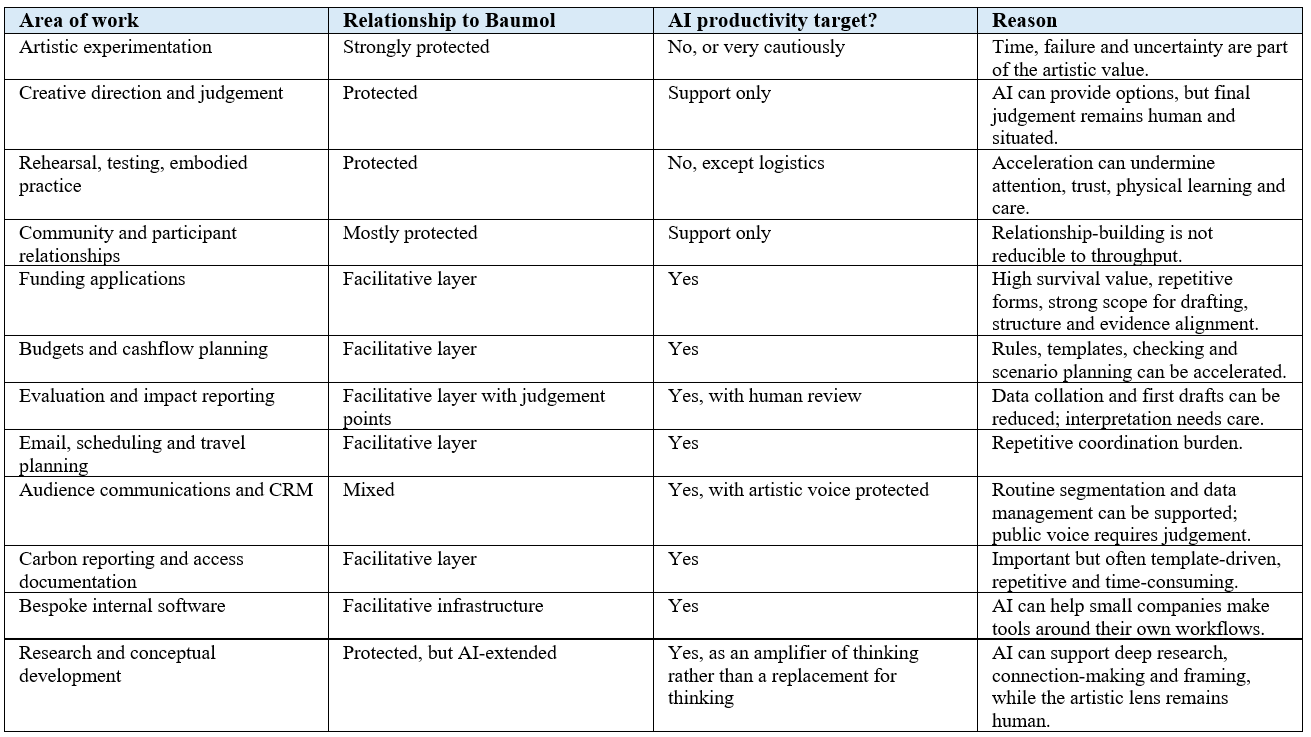
This audit changes the AI question. The issue is not whether AI should or should not be used in the arts. The issue is where it should be used. A blanket rejection of AI may leave artists trapped inside avoidable administrative labour. A blanket embrace of AI may expose the protected creative core to inappropriate productivity pressure. The Baumol boundary offers a way to choose.
5. AGO, bid-writing and the cost of unpaid survival work
The clearest BRiGHTBLACK example is funding. In 2025, a particularly bad financial year for us, BRiGHTBLACK wrote four successful bids. But we also spent approximately 64 people-days writing around £600,000 worth of unsuccessful funding applications. That is roughly two months of unpaid labour: two months in which the company was working to survive, but not being paid, two months in which we could have been making art.
This is precisely the kind of labour that sits on the facilitative side of the Baumol boundary. It is necessary to make art happen, but it is not the same as making art. It requires judgement, strategy, evidence, budgets and care – some of which can be done with AI - and it is also full of repetition, reformatting, funder-specific language, duplicated project description, eligibility checking and translation between artistic intention and application form logic.
In response, BRiGHTBLACK built a piece of bid-writing software. It went through three versions and is now called AGO, because the final version is agnostic: it can be used on any bid, irrespective of funder. AGO uses large language model technologies to structure, interrogate and improve applications. It does not simply make bid-writing faster. It helps us make bids more coherent, better evidenced, better aligned with funder criteria and more strategically consistent.
The early results are significant. On bids under £30,000, BRiGHTBLACK has so far achieved an 80 percent success rate using this approach. Applications that previously took between three days to a week can now often be produced in three to five hours. That time saving is not an abstract productivity gain. It is recovered creative capacity, recovered management capacity and recovered energy.
AGO is one of several software tools BRiGHTBLACK has built in the last 12 months to streamline the administration and management of our practice. These tools do not only reduce the time spent on tasks we were already doing. They also give us reach into management practices we previously did not have capacity for: more systematic planning, better internal evidence handling, clearer project memory, more consistent communications and more robust organisational learning.
6. AI Protected Creative Practice: a kinder productivity framework
This paper proposes AI Protected Creative Practice as a working name for the framework. It is a kinder productivity model because it refuses to make the artist the object of productivity pressure. The artist is not the inefficient component to be optimised. The target is the avoidable friction around the artist.
In many small arts organisations, productivity language is understandably mistrusted. It can sound like a demand to produce more work, faster, for less money. That is not the argument here. In this paper, productivity means survival: the ability to recover time, reduce cognitive overload, lower administrative drag and remain economically viable enough to continue making work.
AI Protected Creative Practice therefore begins with three principles:
· Protect the slow work. Some activities - experimentation, embodied practice, artistic judgement, deep writing, rehearsal, care and relationship - should not be accelerated.
· Accelerate the survival work. Activities that surround the art but do not constitute the protected creative core should be audited for automation, simplification or AI-assisted redesign.
· Make tools around people. Artists and arts organisations should be supported to build bespoke workflows and software around their own practice, access needs, neurotypes and business structures.
The aim is not a thinner arts sector, nor a sector without skilled producers, administrators, managers or fundraisers. It is a sector where human effort is placed where it has the greatest human value, maximising time and resources allocated to the creative process itself. Management and administration has always been about facilitating art-making, where those activities begin to consume the time, money and cognitive capacity that art-making requires, they need redesign.
7. Productivity as survival, not expansion
The class politics of this argument are central. For the large proportion of successful artists who are backed by inherited wealth, strong networks, institutional confidence and financial buffers, administrative inefficiency may be frustrating but survivable. For artists without those protections, it can be exclusionary.
The Sutton Trust’s report A Class Act describes severe class inequalities in access to creative higher education and creative occupations. It argues that key parts of the sector are accessible only to an already advantaged few, and that creative higher education contributes to extremely low social mobility in the creative sector. Creative PEC’s State of the Nations work likewise finds a stable over-representation of people from managerial and professional backgrounds in arts, culture and heritage occupations.
This matters because the hidden labour of artistic survival is not evenly distributed. Writing repeated bids, interpreting funder criteria, attending unpaid networking events, creating marketing content, producing reports, negotiating contracts, learning unfamiliar software, maintaining databases and managing constant uncertainty all require time and confidence. People with money, networks and institutional fluency can absorb more of that burden. People without those assets are more likely to be pushed out.
In that context, AI-assisted productivity should not be framed as a way for successful artists to scale faster. It should be framed as access infrastructure for artists and small organisations who are trying to survive. Reducing administrative friction is not a luxury. It may be a condition of remaining in the sector.
8. Artists are thinkers, not only content makers
A second problem in some writing about AI and the arts is that artists are too often treated as content makers. In that frame, the future artist becomes an orchestrator of multiple AI agents that produce images, text, sound, video, games or other outputs. That prediction may describe one part of future practice, but it misses something fundamental.
Artists are not first and foremost content units. Artists are thinkers. They construct novel lenses, framings and conditions of attention. They help audiences experience the world differently.
“At BRiGHTBLACK, we often describe our role as creating work that renders the audience’s assumptions temporarily inadequate.”
Simon Wilkinson - BRiGHTBLACK
This is one of the places where AI has had a major impact on BRiGHTBLACK’s practice. It allows us to do extremely deep research quickly, with far lower time and carbon cost than many previous research processes. It helps us connect seemingly unrelated fringe areas of thought, compare theories, test analogies, interrogate assumptions and create new narrative framings more quickly and more deeply. This is not the automation of art-making. It is an expansion of the thinking conditions from which art can emerge.
At BRiGHTBLACK we increasingly think of the physical object or installation not as the artwork itself, but as the tombstone to the artwork. The real artwork is the thinking work that makes the physical object possible: the lens, the framing, the research constellation, the events and interactions that the object records.
The analogy is closer to physics than product design. The artwork is not simply made of things. It is made of events, relationships, interactions and shifts in perception. The object remains important, but it is not the whole artistic event. AI matters here because it can support artists in building richer conceptual fields before anything is made.
9. The administrative turn and the professional-managerial arts sector
The wider evidence suggests that publicly funded arts practice has become increasingly shaped by audit, reporting, evaluation, income diversification, measurable impact, marketing, partnership management and organisational resilience. Belfiore’s work on the subsidised cultural sector in the New Public Management describes the spread of audit culture and instrumental policy in Britain, including pressure to measure arts impacts in clear and quantifiable ways. Ashton’s work on organisational portfolio precarity describes arts organisations managing multiple income sources, timelines and funder requirements under conditions of austerity and accountability.
This does not mean managers are the enemy of artists. Many producers, administrators, fundraisers and managers hold the sector together under impossible conditions. The issue is not the existence of management. The issue is the growth of systems of management, reporting, bidding, evaluation and compliance beyond the point where they facilitate making, into a zone where they begin to compete with making.
The idea of the professional-managerial class is relevant here, but it must be used carefully. The problem is not individual arts managers. The problem is the absorption of managerial language, structure and labour into arts practice to such a degree that artists and small companies can spend more time proving, packaging and administering cultural value than creating it.
For this paper, the focus is not to make a sweeping claim about the entire arts sector. The focus is the individual artist and the small arts company. The question is: how much of their time, money, attention and confidence is being absorbed by survival in the form of administration and management, and how much of that burden can be reduced through targeted AI-powered tools?
10. BRiGHTBLACK and Electric Dreaming as early evidence
BRiGHTBLACK’s own practice provides one form of evidence. We have repeatedly encountered problems where generic software subscriptions only partially meet our needs. The tool may solve 30 percent of the problem, but bring with it cost, unnecessary complexity, data friction or a workflow designed for a different type of organisation. With AI-assisted coding, we have often been able to create small bespoke tools quickly, sometimes within an hour, that fit a much higher proportion of the need because they are designed around our actual blockage.
Electric Dreaming Lab provides a second form of early evidence. Seven artists attended our programme in June 2026 at Cambridge University’s Jesus College in collaboration with academics from The Leverhulme Centre for the Future of Intelligence. Those artists were aware that one major agenda was to reduce administrative and management burdens on their individual practices. On the first day, five out of seven participants were able to successfully create a piece of working software using large language models to vibe code in python. Only two of these participants had even a basic background of tinkering with code.
The reasons these artists gave for applying to the scheme also matters. Rankings currently collated from six participating artists show that only one placed the use of creative AI tools as their main reason for applying. The strongest cluster of motivations related instead to the use of AI for survival related activity; reducing administration and management burdens, overcoming career barriers and building communities around their work. These are not separate from art-making. They are the conditions that allow art-making to continue.
“Having next to no experience in coding, I found vibe coding surprisingly easy, and I was so surprised at the possibilities and the scope of tools that I could now create to have at my fingertips. I like how if you don’t understand anything, you can ask the AI to explain it simply and break down the steps even further, so it is completely accessible to people with no experience. I built an app that takes funding guidance documents, analyses and summarises them. I can then give it my CVs and experience, and an explanation of what I would like my funding application to be about, and the app analyses my CVs against the guidance documents and creates a draft. It then gives the draft a score out of 100 on how much it matches with the guidance documentation, and gives me pointers on how to improve it.”
- Kiri Horikiri White, Electric Dreaming Lab participant
On day one Hafza Yusuf built an AI powered advisor for her arts business which included a funder finder and business strategy advice among other services. She had no previous coding experience. By the end of the fifth day everyone in the group had successfully created software solutions with the majority focusing on survival related solutions.
”Learning vibe coding felt surprisingly accessible. It was challenging at first because I had never seen myself as someone who could build software, but the process gave me confidence and a new sense of possibility. I was able to build apps that directly respond to the needs of my practice, from supporting planning and organisation to helping with the kinds of admin work that usually takes up so much time. ”
- Kiri Horikiri White, Electric Dreaming Lab participant
These examples are not yet a formal study. They are observations that generate a research hypothesis: with simple training, artists can learn to build small, bespoke AI-assisted tools that reduce the friction of their own practice. The implication is significant. Artists may not need to be given one standardised platform. They may need capacity-building that allows them to build and adapt their own tools.
11. AI, bespoke software and the end of forced fit
A striking feature of AI-assisted software building is that it reverses the normal relationship between people and tools. Traditional software often asks artists to adapt their practice to the product. Generative AI makes it increasingly possible to adapt software to the artist.
This is especially important for small arts organisations, disabled artists and neurodivergent-led companies. In BRiGHTBLACK’s case, neurodivergence is not an add-on to the business. It shapes attention, communication, overload, pace, friction, confidence, document handling and recovery. A workflow that is efficient for one organisation may be punishing for another. A tool that reduces friction for one artist may create barriers for a different artist.
Bespoke software should therefore be understood as access practice, not merely technical convenience. If AI helps a neurodivergent artist create a bidding tool that breaks a funder form into manageable stages, or a producer creates a planning assistant that reduces working-memory load, or a small company create its own CRM that matches how it actually communicates, then the productivity gain is also an access gain.
“The tools I built are going to be life changing for me, as I have been diagnosed with the hidden disability Chronic Fatigue Syndrome/Myalgic Encephalomyelitis (ME), and so the tools will mean that administrative burden will be reduced significantly, conserving my time and energy for actually creating art, as well as hopefully improving my chances of success in applications.”
- Kiri Horikiri White, Electric Dreaming Lab participant
This is not a call for artists to become software companies. It is a call for artists to become capable of making small tools in the same spirit that they already make props, rehearsal methods, audience journeys, installation layouts, story worlds and production systems. The tool is part of the practice environment.
12. The link with Cognitive Density
This paper should be read alongside BRiGHTBLACK’s earlier work on Cognitive Density: Executive Load, Fatigue and Recovery in AI-Assisted Work. That paper argues that AI can compress making time while increasing decision density. In other words, AI may remove some forms of labour while intensifying others. A task that once took a week may now take a day, but that day may contain a week’s worth of decisions.
AI Protected Creative Practice therefore cannot be naive about AI. AI may reduce administrative burden, but it can also increase executive load, context switching and decision saturation. The correct question is not simply whether a task becomes faster. It is whether the total cognitive and economic cost of the task is reduced in a healthy way.
This is another reason for a kinder framework. AI adoption should not create a new regime of exhaustion in which artists are expected to administer, produce, market, fundraise and iterate at impossible speed. The purpose is recovery of creative capacity, not intensification of all labour.
13. Research proposal: what should be tested next?
This paper combines observation and proposal. The observation is that BRiGHTBLACK and Electric Dreaming artists have already experienced meaningful reductions in specific administrative frictions through AI-assisted bespoke tools. The proposal is that this should now be tested systematically across a wider sample of artists and arts organisations.
A future research programme could ask:
· Which tasks in small arts organisations sit inside the protected creative core, and which sit in the facilitative layer?
· How much time do artists currently spend on funding, reporting, communications, compliance, evaluation, scheduling and software administration?
· Which of these tasks can be safely accelerated without reducing artistic quality, care, access or accountability?
· What changes when artists are trained to build their own AI-assisted tools rather than being given standardised software?
· How do class background, disability, neurodivergence, geography and organisational scale affect the burden of administrative labour?
· Does AI-assisted administrative reduction increase time for making, rest, experimentation, paid artist labour or audience relationship?
· Where are human producers, administrators and managers most valuable, and where are they currently trapped in low-value repetitive labour?
· How does AI-supported research change the thinking work of artists, not only the production of artistic objects?
The research should avoid treating AI as either magic solution or existential threat. It should instead examine which parts of arts labour can be made lighter, and what artists do with the time, energy and confidence recovered.
14. Conclusion: the central question
The central question is no longer simply: how can AI help artists? That question is too broad and too easily captured by either hype or fear.
The better question is: which parts of artistic work should remain slow, human, relational and protected from productivity pressure, and which surrounding systems can be made lighter, faster and less extractive?
Baumol’s cost disease helps explain why the core of artistic practice cannot be treated like a factory. But it does not require artists to remain trapped in every form of administrative labour that has accumulated around art-making. AI gives the sector a chance to make a more precise distinction.
If used badly, AI could become another pressure on artists to make more, faster, with less support. If used carefully, it could do the opposite. It could protect the fragile, slow and human parts of creative practice by reducing the avoidable labour that surrounds them. For artists without wealth, networks or institutional backing, that difference may be a matter of survival.
AI Protected Creative Practice is therefore not a technology-first framework. It is a values-first framework. It asks artists and small arts companies to decide what must be protected, what can be redesigned and where human labour matters most.
Initial references
Anantrasirichai, N. and Bull, D. (2020) Artificial Intelligence in the Creative Industries: A Review. arXiv.
Artquest (2025) Restore the Arts: impact, precarity, and action, in National Portfolio Organisations 2023-2028.
Arts Council England (2014) National Portfolio Organisations Annual Submission 2012/13.
Ashton, D. (2022/2023) Funding arts and culture: everyday experiences and organisational portfolio precarity. European Journal of Cultural Studies.
Baumol, W. J. and Bowen, W. G. (1966) Performing Arts: The Economic Dilemma. New York: Twentieth Century Fund.
Belfiore, E. (2004) Auditing Culture: the subsidized cultural sector in the New Public Management. International Journal of Cultural Policy, 10(2), pp. 183-202.
Creative PEC (2025) Arts, culture and heritage: Recent trends in UK workforce and engagement in England. Creative PEC State of the Nations report.
Heilbrun, J. (2003) Baumol’s cost disease, in R. Towse (ed.) A Handbook of Cultural Economics.
Sutton Trust (2024) A Class Act: Social mobility and the creative industries.
Wilkinson, S. / BRiGHTBLACK (2026) Cognitive Density: Executive Load, Fatigue and Recovery in AI-Assisted Work. Practice research paper