

Abstract
A large proportion of the discussions of how artificial intelligence affects artists focus exclusively on the image of a cultural worker positioned at the centre of a hub of AI agents that can produce more images, words, variations and promotional assets at lower cost. This is a coherent account of AI for one artistic function, to produce content. But it is not an adequate or complete enough account for the artist whose work is to question, reframe or alter the apparatus through which a society understands itself.
This paper distinguishes between the artist-decorator and the artist-mechanic. The decorator supplies an existing machine with cultural material, identity, legitimacy or attention. The mechanic opens the machine, diagnoses its assumptions, changes its relations or assembles another apparatus through which meaning can circulate. The distinction is functional rather than moral: either role may involve skill, beauty, innovation and social value. But the distinction matters because the two roles encounter different frictions and therefore require different things from AI.
For the artist-mechanic, the central challenges are not simply speed and output. They include bounded intellectual reach, the need to maintain distance from authority, institutional gatekeeping, the cost of technical experimentation, the difficulty of financing uncertain or experimental work, the need to reach publics before those publics can be proven to exist, and the burden of building complex systems with limited resources. This paper proposes “spiraling out” as a tried-and-tested response: beginning with a focused, low-cost proposition, observing how small audiences respond, and then expanding the work fragment by fragment through additional media, encounters, territories and forms of finance. In this way, challenging works have moved beyond a narrowly defined arts audience and entered the wider public sphere. The paper considers specifically how AI might assist the artist-mechanic both in developing novel framings and in the various stages of spiraling out the reach of a work without requiring excessive budgets, extensive technical expertise or pre-existing institutional networks.
The transmedia project Whilst The Rest Were Sleeping serves as a longitudinal case study of spiraling out in practice. It began as a low-cost online fiction tested within performance lectures, before expanding through an extended online universe of websites, Wikipedia-style pages and social identities; public sticker campaigns; press and broadcast interventions; film; live performance; virtual and augmented reality; and real-time interactions with audiences both in physical spaces and online. Between 2013 and 2018, the project developed from a handful of fabricated websites and a section of a wider lecture on playable artworks into a large-scale venue-takeover work that reached large audiences in twenty-six countries. Rather than being financed through one or two major commissions, its growth was supported incrementally, mainly through touring, speaking and workshop fees. In this sense, the project demonstrates how an artist-mechanic working under the technological and institutional conditions of the 2010s could develop a complex, machine-changing artwork without first securing the level of funding, organisational support or institutional permission that its eventual scale might otherwise have required.
This model nevertheless depended on conditions that cannot be assumed for every artist. The project required one practitioner to possess an unusually broad range of technical skills, to undertake years of research into industrialised persuasion and propaganda, and to absorb much of the labour and risk involved in building the work across multiple forms. This paper considers how AI might reduce some of these barriers for artists who do not begin with the same combination of specific expertise, experience, networks and resources. It argues that AI-assisted workflows can support the artist-mechanic not only in producing content, but in developing novel framings, extending intellectual reach, acquiring technical capabilities, testing propositions, constructing routes to audiences and spiraling a work outward across media, territories and forms of participation to reach real audiences across a broad spectrum of demographics.
The argument is that AI has a distinctive value for the artist-mechanic. It can widen the research field from which a novel frame is formed; accelerate learning and selective self-production; lower the cost of prototypes; coordinate complex worlds; help establish direct relationships with publics; and reduce dependence on any single gatekeeper or source of authority. These affordances do not make AI neutral or reliable. They introduce risks of false knowledge, derivative framing, extraction, surveillance and platform dependence. But they relocate the debate. The central question is not whether AI can make more cultural content. It is whether artists can use AI to overcome the distinctive frictions involved in changing the machine.
Keywords: artificial intelligence; artist-mechanic; artist-decorator; apparatus; court fool; gatekeeping; transmedia; participation; spiralling out; world-building
1. The forecourt: the artist as a jolt to the frame
My earliest clear image of an artist is not set in a studio, theatre or gallery. It is set on the forecourt of a garage in the small working class neighborhood of a rural town in the midlands where I grew up. I was about four years old. My mother had taken me to work with her, where she filled cars with petrol. Behind us, my uncle worked as a mechanic.
A beaten up old car pulled in. The man who stepped out had long hair and paint wiped and spattered across his jeans in many colours. He spoke with my uncle while I watched. He seemed unusually at ease, smiling was the default. He waved at me. There was something in his clothes, his eyes and the way he occupied the space that I could not name. My uncle told me that he was an artist.
Nothing happened in the conventional sense. The man did not perform, exhibit, persuade or explain. Yet his presence fractured the available account of what a person could be in that particular part of the world where I was learning what it meant to be a human being. Until then, the adults around me seemed to belong to a limited number of recognisable social types. This man suggested another category: whose very existence made the local script and the assumptions I had about the world feel incomplete.
The first work performed by the artist-mechanic may be the jolt produced by being in the world differently.
This moment matters because it identifies artistic function before artistic production. The jolt did not depend on an artefact. It occurred through a changed frame. Viktor Shklovsky’s account of defamiliarisation describes art as a way of making perception difficult again, interrupting the automatised recognition through which familiar things disappear from attention (Shklovsky, 1917/1965). The artist on the forecourt produced a minor defamiliarisation of personhood. He rendered the existing categories inadequate.
Years later, school careers advisers repeatedly translated my wish to become an artist into more institutionally legible occupations: graphic designer, illustrator, draughtsman. I mention this not as a judgement on these careers, which can be radical, critical and transformative. It is a judgement on the function being offered. I understood, even before I had the language to explain it, that I was being directed towards receiving instructions and supplying a service. What had attracted me on the forecourt was different: the capacity to alter the frame from which instructions, roles and possible lives become visible.
The scene now appears almost too neatly symbolic. My mother filled machines with fuel. My uncle opened them up, diagnosed them and changed how they worked. Contemporary arguments about AI and art frequently place the artist beside the fuel pump: a producer of cultural material for an apparatus whose purposes and routes are already settled. This paper is concerned with the artist who opens the bonnet.
2. The artist assumed by the AI debate
The dominant image of AI-enabled creativity is an individual surrounded by tools or agents. A prompt becomes a campaign, storyboard, visual identity, soundtrack, video, code base or set of social posts. The artist is imagined as a director, selector or editor of accelerated outputs. The promised benefits are speed, volume, variation, lower labour cost and expanded personal productivity.
This model is especially legible in advertising, design, branded entertainment, commercial media and other fields in which the commission, audience, objective and distribution channel are broadly known in advance. The machine already exists. The task is to feed it more effectively. AI can be judged by how much content it produces, how quickly it produces it, and how well that content performs against a defined brief.
The model is often generalised into a theory of the future artist. Yet it commonly begins from one function and treats that function as the whole category. It assumes that artistic labour is principally the transformation of a brief into an artefact. Even when it celebrates originality, it locates originality inside a production pipeline whose purpose has been supplied by somebody else.
The artist-mechanic’s intellectual reach is rarely a fixed body of knowledge acquired once and then applied to a particular commission or task. More often, it emerges through a lifelong process of learning across diverse specialist and general fields. This learning may be prompted by the practical demands of a specific work, but over the course of an artist’s career it increasingly connects with earlier ideas, experiences, audience interactions and patterns of thought, generating new relationships and novel ways of framing the world. In my own practice, I regard this evolving process of inquiry and reframing as the artwork itself. The objects, performances and products that emerge from it are its gravestones: material markers of the point the artwork had reached at a particular stage in its continuing development.
In this sense, the artist-mechanic often operates as a provisional polymath: not an expert in every discipline, but someone capable of entering unfamiliar areas of thought, acquiring enough understanding to recognise their underlying structures, and carrying useful concepts from one field into another. One of the joys of finding oneself in a room with other artists is the possibility of entering deep, often highly neurodivergent conversations that swoop and dive across disciplines, moving rapidly between technical detail, personal experience, speculative thought and broad cultural patterns. This mode of inquiry is frequently misunderstood. Where the academic researcher’s role often requires sustained depth within a particular discipline, the artist’s role may be to draw upon research from many disciplines and identify patterns that connect them metaphorically, conceptually, structurally or materially. The value of this work does not necessarily lie in producing new specialist knowledge within any one field, but in creating new relationships between existing forms of knowledge and, through those relationships, making previously unavailable ways of thinking visible.
It is in this context that AI becomes particularly significant. Its value lies not simply in its capacity to provide answers, but in its ability to move fluidly between highly specialised and often disconnected fields of thought. In books, the relevant insight may remain buried within hundreds of pages, difficult to locate without days of reading and harder still to connect with ideas contained in other disciplines and other volumes. Search engines make information more accessible, but return uneven mixtures of authoritative sources, weak or misleading material, and commercially promoted results designed to capture attention or generate a sale. The reader must still identify what is credible, discard what is irrelevant and construct the connections between fragments. An AI system can instead follow an inquiry across mathematics, physics, anthropology, deep history and other specialist fields while preserving continuity between them. It can remain with a niche question long enough to examine its technical detail, intellectual history and limitations, while simultaneously tracing its connections to other domains. In this way, AI can accompany a non-specialist from an initially practical question towards a much broader field of conceptual relationships.
The potential of this capacity can already be seen in mathematics, where amateur researchers have used AI to navigate obscure bodies of specialist knowledge and identify connections between techniques that might otherwise have remained inaccessible to them. In some cases, this has contributed to progress on difficult Erdős problems. What matters here is not simply that AI can retrieve mathematical information, but that it can help a person move between highly specific areas of mathematics, recognise possible relationships among them and develop a line of inquiry that crosses established specialist boundaries.
For the artist-mechanic, this represents a significant expansion of intellectual agency. Novel framings often emerge not through mastery of a single discourse, but through collisions between domains that are rarely considered together. AI can shorten the distance between a question and an unfamiliar field, allowing the artist to move from geometry to epistemology, from economics to theatre, or from propaganda theory to interaction design without first gaining formal admission to each discipline. The artist nevertheless remains responsible for judging the value of each connection, testing the accuracy of the information and recognising where the map fails to describe the territory. AI does not replace the provisional polymathic process; it makes that process more continuous, navigable and available.
Meanwhile beyond the conceptualization phase the audience for a particular work may not yet exist. The form may need to be discovered then iterated through encounter. The work may challenge or be an ill fit for the institution that would otherwise commission, programme or distribute it. It may require the artist to build a new apparatus before the proposition can be experienced at all.
For this artist, more content is not necessarily an advantage. Content can thicken an inherited frame just as easily as it can alter one. The central task is to formulate a proposition capable of making an audience’s assumptions inadequate and then to construct the conditions under which that proposition can travel and reach not just an arts audience, but everyone. AI is therefore valuable in different places: before and around production, as a means of research, synthesis, learning, prototyping, coordination, translation, infrastructure-building and direct relation with publics.
Before asking what AI does to the artist, we must ask which artist the argument has placed at its centre.
3. The artist-decorator and the artist-mechanic
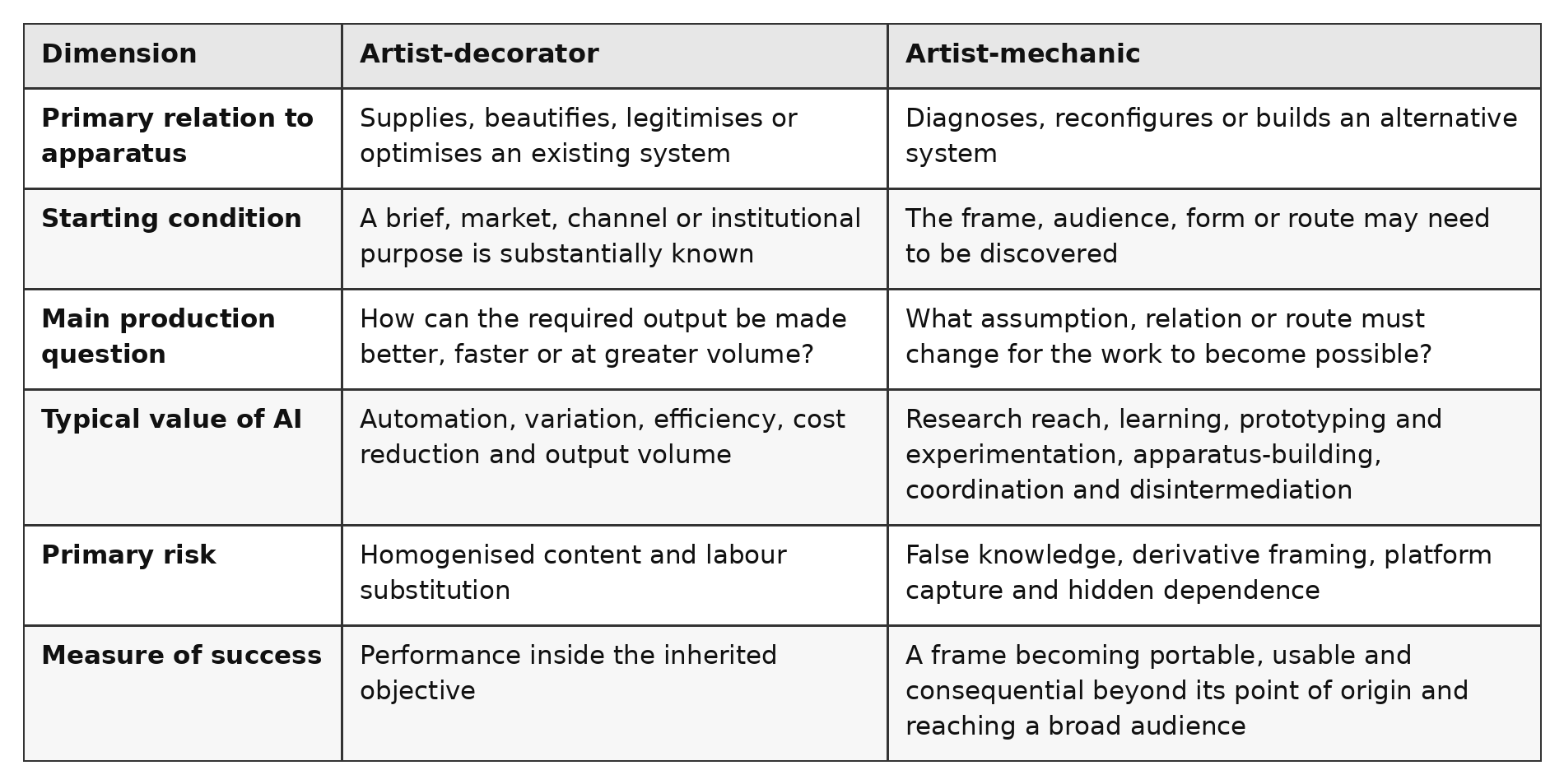
The distinction developed here is intentionally sharp because the current AI debate and wider arts debate increasingly blurs two very different artistic functions. It is not a taxonomy of good and bad people, nor a claim that an individual remains permanently on one side. It is a distinction between what artistic labour is doing in relation to an apparatus.
3.1 The artist-decorator
The artist-decorator gives an existing order a face, soundtrack, atmosphere, ceremony, monument, brand or story about itself. States, religions, monarchies, legal systems, enforcement agencies, corporations, products, armies, movements, military actions and markets have always needed images and performances that make their authority appear natural, innate, desirable, inevitable or magnificent. Toby Clark’s history of propaganda shows how political imagery moves across fine art, posters, photography, spectacle and mass media while serving programmes of persuasion (Clark, 1997).
“Decoration” does not mean superficiality. Decorative labour can be intellectually complex, technically radical and aesthetically extraordinary. Nor is it limited to explicit propaganda. It includes the vast volume of cultural labour devoted to maintaining attention, differentiating products, polishing institutional identity, advertising, converting policy into feeling and feeding established channels with material calibrated for their audiences.
The defining feature is relational. The decorator works inside a purpose, brief or apparatus whose basic arrangement remains intact. The artist may innovate within the system, but the system decides what the innovation is for. AI fits this role readily and many commercial AI products are in fact tailor made for it. It can automate variations, compress production cycles, translate a brief across media and allow one worker to direct a larger volume of outputs.
3.2 The artist-mechanic
The artist-mechanic alters the systems through which perception, legitimacy and participation are organised. They may expose an assumption concealed within an institution, change who is permitted to speak, construct an unfamiliar relationship between media, or create a form through which people can experience a problem rather than simply receive an opinion about it. The artist’s role is often to widen the angle of the lens: to bring broader histories, neglected perspectives, material conditions and underlying structures into view, and to reveal how apparently separate forces act upon one another. Rather than directing the audience towards a predetermined conclusion, the artist-mechanic often creates the conditions in which they can recognise those relationships, inhabit their tensions and form conclusions of their own.
Antonio Gramsci’s account of hegemony is useful because it describes how historically contingent arrangements become “common sense”: the unexamined background against which reality appears natural (Gramsci, 1971). Jacques Rancière’s “distribution of the sensible” names the organisation of what can be perceived, said, heard and recognised as belonging to a shared world (Rancière, 2004). The artist-mechanic intervenes at this level. The work does not merely state a different view inside the frame. It changes what the frame makes available.
Walter Benjamin provides the most direct formulation. In “The Author as Producer,” he argues that cultural workers should not merely supply a production apparatus, even with apparently radical content; they should seek to transform the apparatus itself (Benjamin, 1934/1970). This shifts evaluation away from message alone. The questions become: Who is able to enter? What relations are produced? How does the work travel? Who owns the route? What kind of audience does the apparatus bring into being?
In my own practice over the past twenty years, I have used a range of interactive technologies to construct spaces whose central organising principle is neither persuasive nor dominatory. Within them, audiences are given the agency, individually and collectively, to confront a problem, inhabit a situation or test possible responses without material risk. These works have developed against the grain of a wider technological culture that has become increasingly surveillant, manipulative and authoritarian, and in which profound challenges to democratic life are beginning to appear normal. They proceed from the idea that it is the audience, rather than the director or writer, who should receive the flowers: the work is completed through their decisions, relationships and discoveries. Its outcomes can then be reflected back upon the wider society from which the participants have temporarily stepped. The aim is not merely to represent alternative social relations, but to construct forms in which audiences can encounter and test modes of participation that do not depend upon coercion, behavioural direction or control.
In this sense, the artist-mechanic may produce objects, films, songs, images or performances, but these outputs function as components of a larger intervention. Marcel Duchamp’s readymades altered the conditions under which an object could be recognised as art. Frida Kahlo’s self-representation brought pain, disability, gender, intimacy and national identity into a visual language that refused their conventional separation. Bob Marley’s music carried across borders a portable vocabulary of postcolonial dignity, spiritual resistance, political solidarity and emotional affiliation. Banksy uses anonymity, public placement, visual economy and media circulation so that the route by which an image appears, travels and is reproduced becomes part of its meaning. These examples are significant not only because each artist performed the role of the artist-mechanic, but because they did so while reaching large and socially diverse audiences. Each demonstrates, in a different way, how an artistic practice can produce a frame that enters everyday culture and becomes available for people to use in understanding the world.
3.3 The difference is not medium, market or style
No medium belongs naturally to either function. Graphic design can change a machine, while an installation presented as critical art can serve primarily as prestige decoration for a powerful institution. A protest image can reproduce the hierarchy it condemns; a commercial commission can introduce an enduring critical frame. The relevant question is not whether the work is popular or difficult, digital or analogue, paid or unpaid. It is what the work does to the frame and to the relations around it.
The distinction is also not identical to opposition. An artist-mechanic does not need to shout against the machine. Some of the most consequential interventions are lateral: a new category, an unfamiliar interface, a fiction that changes how evidence is trusted, or a world that allows people to inhabit an alternative relation. The artist-mechanic’s work may be joyful, subtle, seductive or apparently apolitical. Its critical force lies in changing the conditions of sense.
Table 1. Two artistic functions and their distinct requirements of AI
3.4 The fool: proximity without identity
The court fool offers a historical figure for the mechanic’s difficult relation to power. The fool is neither fully outside nor securely inside the court. The role depends on proximity: the interruption must be close enough to register. It also depends on difference: the fool must retain enough non-identity with authority to say what ceremony cannot say.
Studies of fools and jesters describe figures who could mock rank, invert decorum, expose vanity and sometimes tell truths that would be dangerous in another mouth (Welsford, 1935; Otto, 2001). Bakhtin’s account of carnival widens this function to collective reversals in which official seriousness is suspended and excluded voices become temporarily central (Bakhtin, 1984). Foucault’s work on parrhesia adds the element of risk: truth-telling gains force when it is addressed to power without the protection of equal status (Foucault, 2001).
The modern artist-mechanic occupies a related position. Complete exclusion from power can preserve independence while removing the resources and platforms through which an intervention becomes consequential. Complete incorporation can provide resources while converting critique into ceremony. The desired condition is not purity. It is workable distance.
Arm’s-length cultural support can be understood as an attempt to construct that distance. Public resources are made available through structures intended, at least in principle, to prevent political or commercial authority from determining the content of artistic work directly (Hillman-Chartrand and McCaughey, 1989). The democratic purpose of support is not merely to fund production. It is to protect a social location from which difficult questions can be formed.
4. The distinctive frictions of the artist-mechanic
The artist-decorator and the artist-mechanic may use the same media, share the same economic insecurity and sometimes be embodied by the same person. Their central working problems are nevertheless different. The decorator usually begins with a purpose, brief, market or channel that is substantially known. The principal difficulty is producing effectively within those conditions. The mechanic begins with uncertainty: the frame, form, audience, route and even the apparatus may need to be discovered. AI therefore cannot be evaluated for the artist-mechanic only by measuring speed, volume or the quality of generated outputs.
The artist-decorator begins with a brief and needs capacity. The artist-mechanic begins with uncertainty and needs room to discover what the brief should have been.
4.1 Epistemic friction: reaching the material from which a frame can be formed
A novel frame normally requires movement across histories, disciplines, communities and forms of knowledge. The mechanic may need to connect economic data, political theory, ritual, personal memory, interface design, propaganda, popular culture and conversations with strangers before an adequate proposition appears. The work of making begins before the artefact: it begins with finding a relationship that was not previously available as a way of seeing.
This labour is slow and unevenly distributed. Time, education, travel, language, libraries, archives, specialist networks and financial security determine how widely an artist can range. The mythology of inspiration conceals the accumulated reading, making and observation that allow an unusual connection to become recognisable. The first friction is therefore not simply the cost of producing a work. It is the cost of reaching enough intellectual territory to know what the work is for.
4.2 Authority friction: acquiring resources without surrendering the frame
The artist-mechanic needs resources while preserving enough distance from the authorities, markets or institutions being examined. Complete exclusion can preserve independence while removing consequence. Complete incorporation can provide consequence while converting critique into ceremony. The problem resembles the historical position of the fool: close enough to the court to be heard, but not so identified with the court that the speech becomes another part of its self-image.
The decorator is often valuable precisely because the purpose of the authority and the purpose of the work are aligned. For the mechanic, alignment can be dangerous. A dominant commissioner, sponsor, venue or technical partner can begin to determine the language, timetable, risk tolerance and public route of the work. The friction is not the existence of support; it is dependence on a source of support powerful enough to define what the intervention is allowed to become.
4.3 Permission friction: reaching publics before those publics can be proven
Across a long-form practice, a recurrent distinction emerges between audience response and access to audiences. Over the course of my own thirty-plus-year career, I have repeatedly found that work which performs powerfully with audiences is not always the work that performs well with the curators, programmers, commissioning systems and funding assessments that determine whether it reaches them in the first place. Where those structures have been bypassed, audiences have often grown, the debates generated by the work have been more substantial, and the work has taken on a life of its own across different geographical and demographic contexts. Yet reaching audiences without the institutional endorsement, infrastructure, resources and networks that normally provide access to them can be a slow and difficult process.
This does not make gatekeepers enemies. Curators can be advocates, translators and risk-takers. The friction is structural. The criteria by which work is permitted to meet a public are not identical to the criteria by which the public later values it. The artist is required to make the work twice: once for the encounter and once for the permission system. The second version must often demonstrate strategic fit, financial certainty, recognisable relevance and a proven audience before the first encounter has occurred. The mechanic faces a circular demand: prove the public before being allowed to meet it.
4.4 Production friction: testing forms whose value is not yet known
Mechanic work frequently requires a form that cannot be specified at the outset. The artist may need to test a game mechanic, interactive archive, responsive environment, broadcast fiction, online character, spatial interface or combination of media before knowing which element carries the frame. Each technical question can require a new collaborator, fee, schedule and round of explanation.
Collaboration is often essential and should not be reduced to a cost. Yet when every experimental turn depends on external specialist capacity, the work is constrained by available capital and by the need to make an uncertain proposition legible before it can be tried. The mechanic needs enough technical literacy and selective self-production capacity to keep the experiment alive between larger collaborations. Learning becomes part of artistic autonomy.
4.5 Financing friction: emergent work inside systems that require certainty
Large, distributed or transmedia work is often difficult to fund as a single proposition precisely because its value emerges through iteration. A conventional application may ask for a stable object, a fixed audience, a complete budget, a delivery plan and measurable outcomes before the public encounter that would make those things knowable. The mechanic is asked to make uncertainty administratively invisible.
Upfront finance can also intensify proximity to authority. When a single institution supplies most of the resources, the project becomes vulnerable to that institution’s timetable, narrative and appetite for risk. The mechanic must therefore secure enough support to increase the work’s consequence without allowing any one financial decision to determine whether the frame can exist at all. Even well-designed funding structures can sit awkwardly alongside the fluidity of experimentation and risk. Projects may become trapped in repeated prototype cycles, while artists are drawn into seemingly inescapable client-cycle relationships with the very organisations established to support them. In this way, structures intended to enable development can instead contain it, repeatedly funding the promise of transformation while making the conditions for its full realisation harder to reach.
4.6 Distribution friction: carrying difficult work beyond an arts audience
Many people do not feel at home in arts venues, do not follow specialist cultural media and will never encounter work available only after curatorial selection. An artist-mechanic who wants to change a public frame must solve not only the artwork but the route. Public space, broadcasts, games, social media, community encounters, workshops and online worlds may be artistic thresholds rather than promotional channels.
The problem is not simply audience size. It is demographic and cultural reach. Different publics enter through different habits, vocabularies and levels of trust. A feature-length live film, a sticker in a city, a radio interview, an online mystery and a virtual-reality installation do not merely advertise the same object. They establish different relationships to the proposition and allow challenging questions to travel outside the social group already equipped to recognise them as art.
4.7 Organisational friction: maintaining a complex world with limited resources
As a work expands across media, the artist must manage continuity, technical dependencies, versions, characters, archives, collaborators, touring logistics, budgets and public communication. The administrative shadow grows faster than the visible artefact. Artist-mechanic work can be defeated not by a lack of ideas but by the coordination required to keep the apparatus coherent.
4.8 Legitimacy friction: disclosing the mechanism without neutralising it
A work that directly names its critical mechanism may become impossible to programme, easy to neutralise or incapable of producing the experience on which the critique depends. Some curators may support the underlying question; others may encounter the work first through its form or audience appeal. The mechanic must decide how much of the mechanism can be made explicit at each threshold.
This is not necessarily deception. It is a problem of timing and dramaturgy. A work about persuasion may need to persuade before it can reveal the structure of persuasion. A work about institutional language may need to pass through institutional language without allowing that language to determine the final encounter. The decorator normally benefits from legibility to the commissioning apparatus. The mechanic may need to control the sequence through which legibility arrives.
5. AI as a friction-reduction system for the artist-mechanic
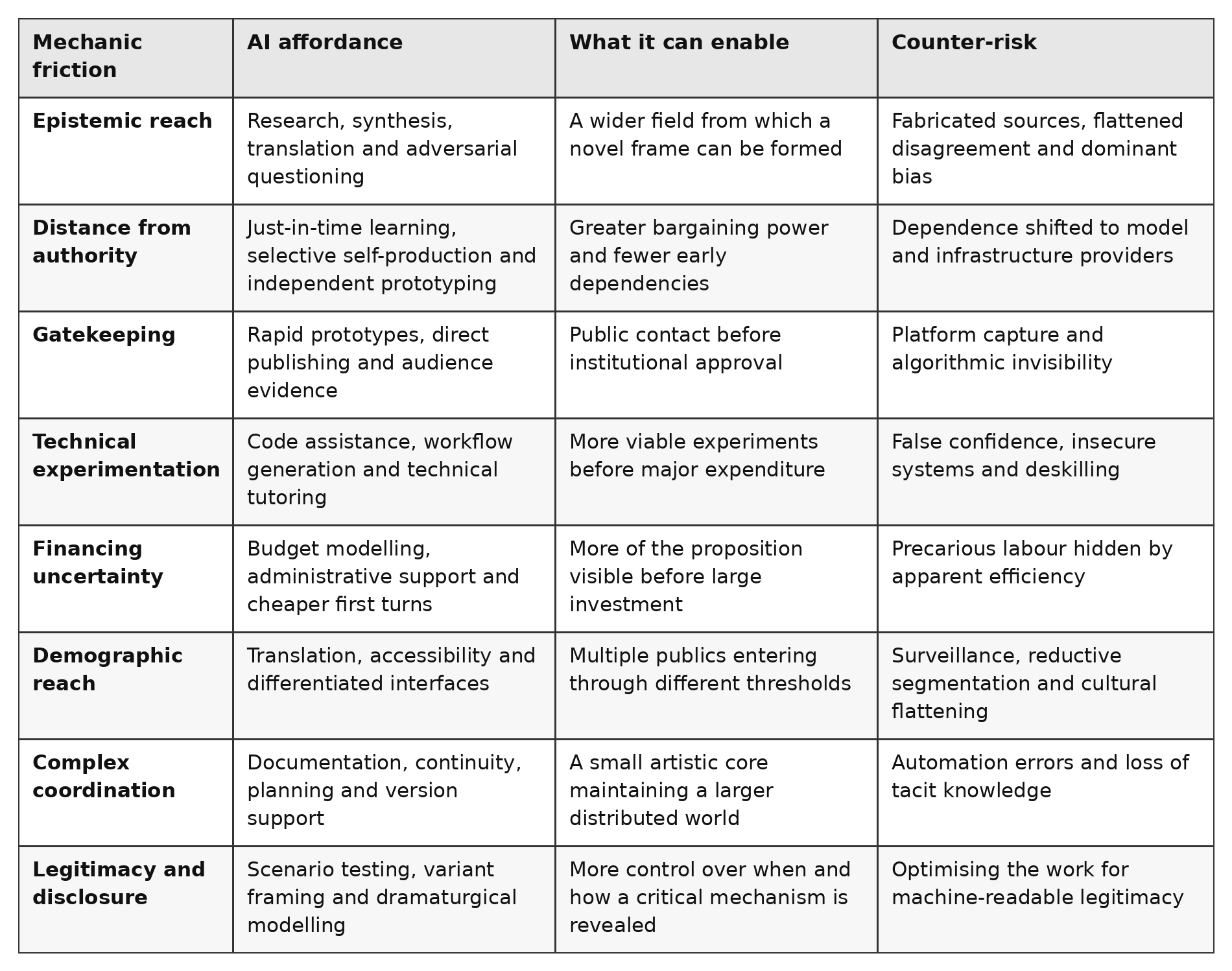
AI enters the argument only after the two artistic functions have been separated. The distinction determines what usefulness means. For the decorator, AI mainly increases productive capacity inside an apparatus whose objectives are already known. For the mechanic, AI is potentially more consequential before, around and between acts of production. It can reduce the circumstantial frictions that prevent a novel frame from being formed, tested, financed, maintained and carried into public life.
For each recurring friction faced by the artist-mechanic, AI offers a corresponding affordance. An affordance is not a guaranteed solution; it changes what one artist or small team can attempt before seeking permission.
5.1 Epistemic friction becomes intellectual reach
Large language models provide fluid reach across bodies of information otherwise separated by disciplinary vocabulary, institutional access, geography and time. They can surface thinkers, historical analogies, counterarguments and technical vocabularies; translate between specialist and public language; generate research questions; structure interviews; compare conceptual traditions; and expose a provisional idea to sustained criticism.
The system does not supply the decisive frame merely by recombining information. The mechanic must still recognise which connection matters, understand the lived and political stakes, distinguish analogy from equivalence, and test the frame in contact with people. AI expands the surface area from which synthesis can occur. Its value is not that it thinks instead of the artist, but that it can reduce the friction of reaching, organising and contesting relevant intellectual territory.
5.2 Authority friction becomes selective autonomy
AI-assisted learning, coding, documentation and workflow design can allow an artist to build more of the first viable apparatus without making every experimental question dependent on a specialist supplier or institutional partner. This can preserve uncertainty for longer and give the artist more control over the pace at which the work becomes legible to others.
The objective is not to eliminate creative practitioners or treat collaboration as a removable cost. Collaboration can introduce knowledge, resistance and difference that no tool can substitute. The value lies in choosing collaboration because it is artistically necessary rather than because the artist cannot test the proposition by any other means. Selective self-production can increase bargaining power and maintain a workable distance from any single authority.
5.3 Permission friction becomes evidence before permission
A low-cost AI-assisted prototype can establish whether people enter, remain, return, share, question or contribute. This evidence can replace some of the speculative language demanded by applications and programming processes. The mechanic approaches the gate with an active proposition and a visible public life rather than with a forecast alone.
More radically, the work may no longer require the gate for every phase. AI can support direct publishing, conversational environments, playable archives and other public-facing systems through which an artist meets people before a curator certifies the project. A venue can then become one threshold in a wider ecology rather than the sole container of the work. The relationship can shift from permission to partnership.
5.4 Production friction becomes cheaper, learnable experimentation
AI can help an artist learn unfamiliar technical processes at the moment they become necessary: coding an interaction, constructing a database, debugging a prototype, designing a workflow, preparing assets, translating documentation or understanding a production tool. It can shorten the interval between an artistic question and a testable form.
Generative and assistive systems can also lower the cost of the first threshold into a world. A mechanic can test a responsive character, virtual environment, interactive archive, multilingual trail or distributed narrative before obtaining the budget for a polished public version. Complex public work still requires craft, safety, hosting, equipment and maintenance. AI changes the sequence by allowing more of the question to become visible before major expenditure.
5.5 Financing friction becomes a more viable first turn
AI does not finance art, but it can reduce the amount of finance needed to reach the first consequential encounter. It can help model budgets, compare production routes, prepare documentation, adapt proposals for different partners, maintain contacts, plan touring variants and identify which component is genuinely expensive rather than merely unfamiliar. These tasks can protect time and make small commissions, speaking fees, workshops, touring income and direct audience support more capable of accumulating into development capital.
This matters because the artist-mechanic often needs distributed finance rather than a single source large enough to define the project. Lower-cost prototypes and lighter administration can help a work demonstrate life before it seeks substantial support. They do not remove precarity, and they should not become an excuse for underfunding. Their value is leverage: the refusal of one source is less likely to terminate the entire apparatus.
5.6 Distribution friction becomes multiple routes to differentiated publics
AI can support multilingual versions, accessible descriptions, adaptive interfaces, community-specific entry points, conversational characters and responsive online encounters. It can help an artist construct thresholds shaped around different habits and levels of prior knowledge without forcing every audience through the same institutional doorway.
The aim is not to generate more promotional material around a fixed artwork. It is to make the distribution architecture part of the artwork. When the critical question appears through a radio conversation, a playable world, a public intervention, a captioned video, a translated interface or an embodied installation, the work can move beyond a narrowly defined arts demographic while preserving complexity. AI can make this multiplicity more achievable for a small team.
5.7 Organisational friction becomes assisted orchestration
A distributed work produces a large administrative shadow. AI can help map dependencies, maintain a transmedia canon, track versions, draft technical documentation, model schedules, organise research, log audience questions, prepare accessibility variants and keep continuity across characters, platforms and territories. These functions are rarely described as creative, yet they often determine whether a complex world survives.
The mechanic can therefore use AI as infrastructure around artistic thought rather than as an automated author at its centre. The practical gain is cognitive: less of the artist’s attention is consumed by repetitive coordination, leaving more available for framing, encounter and revision.
5.8 Legitimacy friction becomes dramaturgical and rhetorical testing
AI can help an artist model how a proposition will be read by different institutions and publics, develop versions of an explanation for different stages of encounter, test the consequences of early disclosure and identify where professional language begins to distort the critical frame. It can assist with the rhetoric surrounding a work without being allowed to define the work itself.
This affordance requires particular caution. A system trained on existing institutional language can easily optimise a project for the very conventions the mechanic is trying to escape. The purpose is not to make the work maximally acceptable. It is to allow the artist to manage timing, translation and disclosure while retaining control of the underlying question.
Table 2. The artist-mechanic’s frictions and corresponding AI affordances
6. Spiraling out as a method of scale and public reach
Spiraling out is one practical response to the frictions described above. It is not the central subject of this paper, and it is developed here only far enough to explain the case study and the way AI can increase the reach of machine-changing work. The method begins with a focused proposition small enough to make without full permission. The artist places it in contact with real people, observes what happens, and then adds another threshold. Each turn expands the apparatus while preserving earlier forms as part of its ecology.
6.1 From a small proposition to public evidence
A lecture may produce a website. A website may generate investigative behaviour. That behaviour may justify a performance. The performance may finance an installation. The installation may lead to a public trail, game, broadcast, workshop or community process. The next form is chosen because it creates a different relationship to the question, not because it supplies another promotional asset.
This differs from conventional scaling. Scaling normally reproduces a stable product for a larger market. Spiraling out changes the work as it expands. New media bring different rhythms, forms of trust, degrees of embodiment and demographic routes. The work accumulates participants, interpretations, territories and capacities. It becomes an apparatus distributed across encounters rather than a single object waiting to be marketed.
6.2 Spiraling out and spiraling in
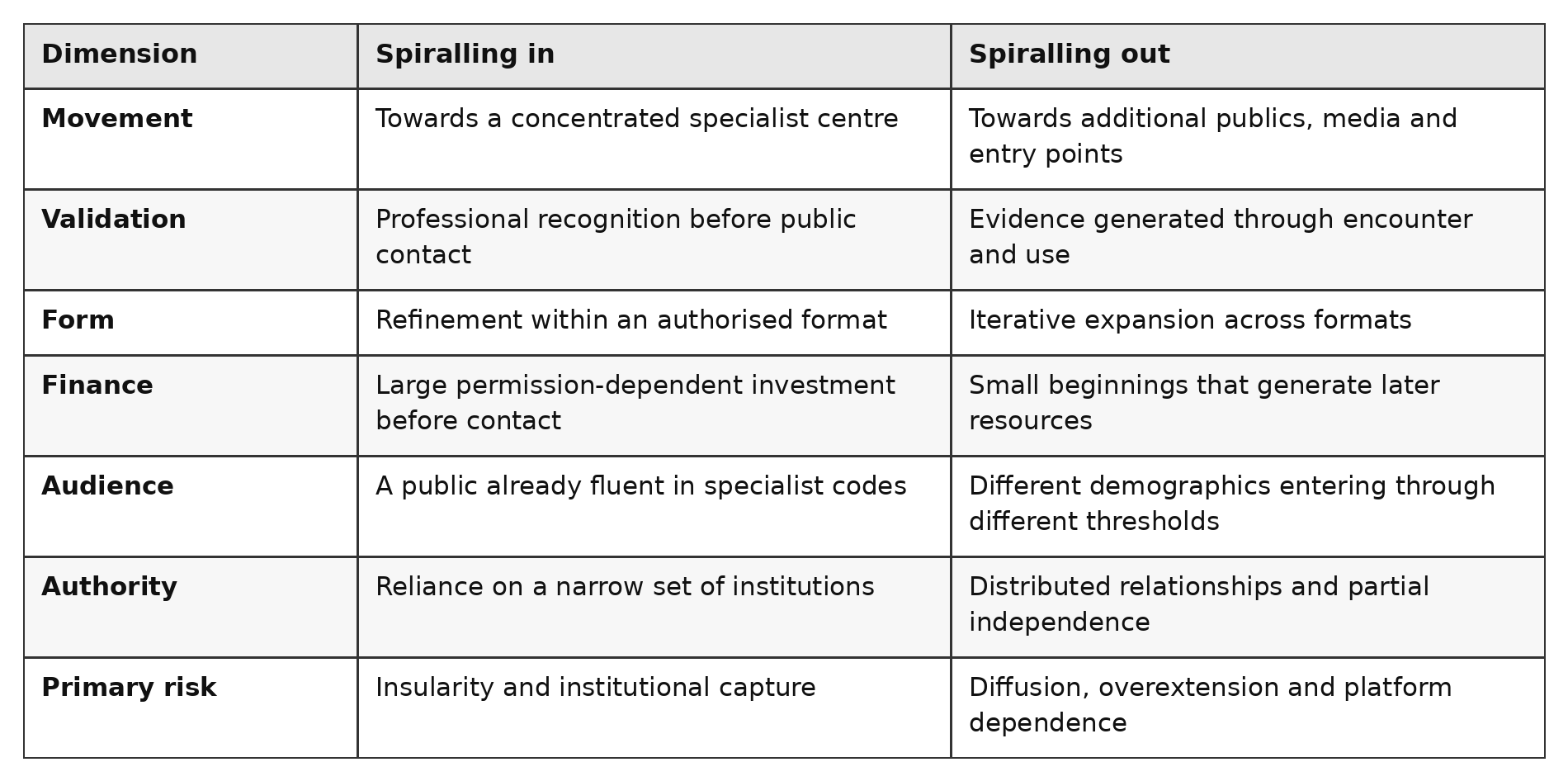
The contrasting tendency is spiraling in: a practice becoming progressively concentrated within specialist references, formats and systems of validation. The work may become theoretically precise and professionally legible while addressing a narrowing public. Its primary audience becomes the people authorised to commission, curate, assess, review or collect it.
Spiraling in is not inherently a failure. Some inquiries require privacy, specialist knowledge or small communities. The danger arises when inward concentration is mistaken for seriousness itself, and when artists must demonstrate fluency in professional codes before being permitted to meet people outside those codes. Spiraling out treats broader public reach as an artistic problem: how can a difficult frame remain difficult while becoming available through more than one cultural doorway?
6.3 Demographic reach and distance from authority
A spiral can carry challenging work beyond an arts audience because different thresholds reach different demographics. A radio interview, a sticker on a wall, a live film, a game, a workshop and a virtual environment do not ask for the same prior knowledge. Each can draw a different public into the same underlying question. The measure is not popularity alone, but whether the frame becomes portable and usable beyond the field that first recognised it.
The spiral also reduces dependence on a single gate. A venue can present one form without owning the world. A commissioner can support one turn without determining every later turn. Touring income, speaking fees, workshop fees, audience relationships and small commissions can combine into a distributed ecology. This does not abolish power: platforms, broadcasters, venues and payment systems remain consequential. It does, however, reduce the likelihood that one refusal or one authority can prevent the work from beginning.
Table 3. Spiralling in and spiralling out as contrasting tendencies
7. Whilst The Rest Were Sleeping: a pre-AI case of artist-mechanic practice and spiraling out
Whilst The Rest Were Sleeping provides a longitudinal example of artist-mechanic practice under the technological and institutional conditions immediately preceding contemporary generative AI. It demonstrates how a critical apparatus could be built from extremely low-cost beginnings, expanded through public evidence and financed across many small encounters. It also makes visible the unusual concentration of research, technical skill, labour and risk that such a method demanded from one practitioner in the era directly prior to AI.
7.1 The initial proposition
In 2013, during performance lectures on playable culture, interactive culture and transmedia storytelling connected to an earlier project, The New Ten Commandments, I described a mass disappearance said to have occurred in 1959. I framed the account through a personal story. At thirteen, I had read about the event in a magazine titled Mysteries of the World, given to me by my grandfather. In the internet age, I said, I had spent hours following the story through intriguing websites, wikipedia pages, memorials, social-media accounts and scattered personal traces.
The audience understood this as a real example used to illuminate a lecture on how transmedia storytelling could give audiences agency to follow their own curiosity through a story: moving across websites, identities and fragments of information in the emerging culture of the hyperlink. The online world I referenced in the lecture, however, was itself the artwork. I had created the websites, Wikipedia pages, social identities and apparently corroborating sources. They were cheap and quick to assemble. Their purpose was to model how belief can be manufactured when repetition appears to emerge from multiple independent places.
The first significant result was behavioural rather than critical. People who attended the lectures went online and followed the trail. Activity across the fabricated sites demonstrated that the story produced curiosity beyond the room. The proposition had life. That evidence justified the next fragment.
7.2 Expanding the thresholds
The project was then built fragment by fragment. Each fragment opened a different route into the same problem of evidence, persuasion and distributed authority. As opportunities opened up to me, both directly related to the story in question, or otherwise, I’d seed more of the story into the public domain, presenting it as a true story and building the web presence to back up its veracity;
Conversations with strangers in bars and cafes
A campaign of 5000 stickers with NONE OF THIS IS REAL printed on them alongside a QR Code across Melbourne city linking to a memorial website for the disappeared
Interviews with journalists, radio stations, TV stations that added to the online repository of references to the story and new entry points for different demographics
Public lectures and panels in which I referenced the story
More websites, Wikipedia pages, social media accounts amounting to about 35 sites in total at the peak in 2017
A feature-length film performed live with an electronic music soundtrack, accompanied by a string quartet, commissioned by Federation Square
17 virtual-reality installations, augmented-reality elements and other interactive forms through which different audiences could encounter fragments of the world spatially and technologically told from different character perspectives.
Live online interaction in which I appeared in character through different guises and responded to participants moving through the fiction, emailing characters, sending messages on facebook messenger.
8 x Live performer roles within the venue take over versions of the show who read extracts of letters from those who disappeared in 1959
I commissioned a prop maker to create a copy of the magazine I read when I was thirteen years old plus artifacts from the original (fake) story including letters and newspaper articles, these were exhibited alongside performances as real objects from the story
Touring, talks and workshops that became both further entry points and mechanisms through which later parts of the work could be financed.
The project was not a stage show with a marketing campaign attached. The broadcasts, stickers, websites, characters, live film, virtual reality, augmented reality and online encounters were all parts of the artistic apparatus. Each medium carried a different relationship to credibility for different audiences and demographics. The sticker produced blended into a street culture aesthetic and drove participation with communities associated with skating, BMX, graffiti. A TV or radio interview borrowed authority from the broadcaster. A fabricated archive rewarded confirmation. A live performance gathered people into a shared temporal event. A virtual-reality installation converted narrative investigation into embodied encounter.
7.3 The reveal and the critical frame
The fictional trail eventually revealed itself as fiction and as an experiment in persuasion. The aim was not simply to trick an audience. It was to make belief available for examination from inside the experience of believing. Participants first practised the habits through which propaganda becomes convincing: searching, corroborating, trusting apparent multiplicity and reading institutional form as evidence. They then encountered the constructed nature of the sources.
The desired movement was from “this story is false” to a more consequential question: “What else do I believe because distributed systems of authority have made it appear independently confirmed?” The artwork was therefore not reducible to any of its objects. Its material was the relationship among media, authority, investigation and audience behaviour.
7.4 A work that could not be financed as one work
As a single proposal, the eventual project would have been exceptionally difficult to finance. It required live performance, film, music, websites, broadcast interventions, public graphics, virtual reality, augmented reality, online character work and touring infrastructure. If it had even been possible to conceive of the piece in its entirety, before evidence of audience behaviour existed, a complete version would have looked expensive, uncertain and administratively implausible.
Spiralling out changed the financial question. The project began with elements already within reach. Once the stage work was touring, touring fees became development capital. Speaking and workshop fees supported further experiments. Additional forms were built while earlier forms were in circulation. Between 2013 and 2018, the work grew into a transmedia world and large-scale venue-takeover production that reached audiences in twenty-six countries.
A later application for support was unsuccessful, but the decision arrived while the work was already on tour in Mexico City having played out at venues across New Zealand, the Western Balkans, North America, Latin America, Australia, Europe, The Middle East, Kenya, South Africa and central Asia. The refusal could limit one route; it could not prevent the work from existing. The practical significance of distributed beginnings is that the artist does not wait for permission to be large. A small apparatus is built that can earn the next turn.
7.5 What the case isolates
The case is not presented as a universal production model or as an argument that artists should absorb unlimited unpaid labour. It identifies a set of capacities that made the work possible: one motivated artist with extensive prior research, broad technical literacy, the ability to construct and maintain many media forms, tolerance for financial uncertainty, direct audience observation, enough networks to start the process and the willingness to carry organisational risk over several years.
Those capacities are exactly where the AI argument becomes concrete. The project supplies a pre-AI benchmark. It shows what one artist could achieve by personally carrying a large amount of research, learning, production, coordination and distribution, and therefore allows a more precise question: which parts of that burden could AI reduce for artists who do not begin with the same time, expertise or networks?
8. A counterfactual: how AI could have changed the work
Because the project was built before current generative AI systems were available, it provides a useful counterfactual. AI would not have supplied the core critical frame. That frame emerged from sustained thinking about propaganda, distributed credibility, performance, interactivity and the experience of belief. Nor would AI have removed the need for judgement, collaboration or public testing. It could, however, have changed the scale, speed, independence and demographic reach with which the frame was developed and circulated.
8.1 More time and territory for framing
Developing the conceptual frame for Whilst the Rest Were Sleeping required sustained research across the history of propaganda, media theory, linguistics, social proof, interface behaviour, broadcast convention, geopolitical history, structures of domination and audience psychology. This involved working through a large body of books, documentary films and websites, then drawing connections between disciplines that did not always speak directly to one another.
AI could have surfaced adjacent histories, generated counter-readings, compared models of persuasion, organised trails of sources and challenged weak assumptions. It would not necessarily have produced a better idea, but it might have allowed more of the artist’s limited time to remain focused on synthesis, ethics and dramaturgy.
In more recent projects, I have undertaken comparable research using many of the same media, while also incorporating large language models. This has allowed me to move more rapidly between fields, interrogate ideas through two-way exchange, cross-reference claims and stress-test emerging arguments as they develop.
8.2 Greater selective production capacity
I built the websites, online material, virtual-reality installations, augmented-reality elements and other technical components myself. AI-assisted coding, debugging, asset preparation, documentation and just-in-time learning could have reduced the cost of each experiment and shortened the interval between audience response and the next iteration.
This matters politically as well as economically. The greater my capacity to construct the apparatus directly, the fewer points at which the project would have needed to become legible to a specialist, supplier or institution before it could proceed. It would have increased the project’s distance from authority without requiring withdrawal from collaboration.
In more recent projects, AI-assisted coding across different programming languages and platforms has not only accelerated the movement between iterations; it has also transformed the complexity of the interactive systems I am able to build. What I can personally create in 2026 would have been almost unthinkable during the period from 2013 to 2018 in which Whilst the Rest Were Sleeping was developed.
One weakness of the original work was the bluntness of the data it could gather about online audience behaviour. It was useful primarily for tracking numbers: how many people engaged, and when. Were I remaking the work today, I could build systems that responded more individually to each audience member, enabled and managed interaction between participants, allowed those interactions to persist meaningfully within the world of the artwork, and generated richer evidence through which to understand and communicate the project’s outcomes.
8.3 Earlier evidence and a lower financial threshold
Cheaper prototyping could have placed more fragments of the work before audiences at an earlier stage. Rather than describing a possible conversational character, interactive archive or localised trail within a funding application, the project could have presented a working version and observed how people actually used it. That evidence could then have informed artistic decisions, strengthened negotiations and supported subsequent rounds of touring, funding and partnership development.
A recent experience provides a useful parallel. Over the past year, I have developed pitch decks and design bibles for several artworks conceived as video games. For one virtual-reality project, I needed to prototype a locomotion system through which the player could move around a space using a wheelchair. I initially built the system with visual scripting tools in the Unity game engine. After a full day’s work, the result was perhaps 70 per cent satisfactory.
Frustrated by my own limitations, I asked ChatGPT to help generate the underlying code. Within an hour, I had a convincing working prototype that allowed the player to navigate an apartment building in a wheelchair using credible physics. What began as a technical experiment became a playable demonstration that potential investors and funders could experience directly. Instead of asking them to imagine the proposed interaction, I could place it in their hands.
8.4 More thresholds for more differentiated publics
AI could have supported additional languages, conversational characters, accessible modes, localised fragments, dynamic archives and responsive online encounters. Different demographic groups might have entered the work through interfaces shaped around their particular habits, needs and contexts, without requiring the project to collapse into a single universal format.
Whilst the Rest Were Sleeping was eventually translated into Turkish and Italian. Each translation required considerable preparatory work, followed by approximately three additional production days to record and integrate the new material. More recently, however, I have developed AI tools that automate captioning and greatly reduce the friction involved in translating work into multiple languages. These tools make it possible to create a far wider range of entry points for more socially and linguistically diverse audiences.
Had such tools been available in 2014, the performances presented across the Western Balkans, Latin America, Central Asia, the Middle East, Kenya and elsewhere could have reached substantially larger local audiences. Translation would no longer have functioned primarily as an expensive adaptation undertaken for selected locations, but as an integral and scalable part of the work’s design.
8.5 A larger world maintained by a smaller artistic core
Seventeen virtual-reality installations, augmented-reality elements, live interactions, websites, characters and touring versions generated an enormous burden of continuity, maintenance and technical administration. There was no small artistic core carrying that work. I carried it alone. AI could have helped manage canon, technical dependencies, audience questions, localisation and version histories, allowing a world that demanded the administrative capacity of a large organisation to remain more sustainably steerable by a single artist.
By the time the work stopped touring at the end of 2018, I was exhausted. Photographs from that period show someone who had pushed themselves too far: I had lost weight, looked exhausted and, towards the end, experienced a breakdown. This is not incidental to the history of the project. It reveals the human cost of requiring one artist to maintain an expanding transmedia world without the organisational infrastructure such a world would ordinarily demand.
Had I possessed today’s AI tools, I could have built systems that substantially collapsed the administrative and managerial burdens surrounding both the project and its touring. The work would still have required artistic commitment, technical judgement and human care, but its expanding complexity would not have had to be carried so directly through my own labour and health.
8.6 A stronger sequence of iterations, not an instant masterpiece
The value of AI in this counterfactual is cumulative. No single generated output transforms the project. The effect comes from lowering the cost and delay of repeated small turns. A cheaper prototype produces an earlier encounter. An earlier encounter produces evidence. Evidence creates income, leverage or partnership. That resource supports another threshold. AI strengthens the capacity to spiral outward by increasing the number of viable experiments.
This counterfactual also marks a limit. AI can make an iteration more feasible; it cannot determine that the iteration is artistically necessary. The artist-mechanic still decides whether a new medium changes the relation to the frame, reaches a genuinely different public or merely increases the volume surrounding the work.
9. Why this is not the “creative worker plus agents” model
The popular image of the AI-enabled artist is a worker directing a team of autonomous agents. One agent researches, another writes, another designs, another edits video, another distributes and another analyses performance. The worker becomes a compact agency. This image is useful when the purpose of the agency, the client, the market and the measure of success are already known.
For the artist-decorator, agents extend production power inside a brief. The artist remains the centre of a content operation. Success is measured through efficiency, output quality and commercial performance.
For the artist-mechanic, the crucial agency is not the ability to order more outputs. It is the ability to preserve uncertainty long enough for a new frame to emerge, then to construct and test the apparatus through which that frame becomes public. AI is valuable where it reduces the circumstantial frictions that normally force the artist-mechanic to simplify, seek permission too early, surrender technical control or abandon a proposition before it has evidence of life.
This is a different political economy of use. The artist-decorator uses AI to become more productive or competitive inside an established apparatus. The artist-mechanic uses AI to reduce the amount of market, institutional, financial and technical permission required to discover whether an alternative apparatus should exist. The first model centres generated content. The second centres intellectual reach, autonomy, experimentation and public relation.
The artist-mechanic does not need an army of agents producing content. They need leverage at the precise points where thought, autonomy, scale and public access usually break down.
10. Implications for artists and cultural institutions
The artist-mechanic framework changes the questions that should be asked of AI in cultural practice. It directs attention away from output volume and towards the points at which critical inquiry normally loses autonomy, finance, technical viability or public reach. It also changes how institutions might support work whose form, audience and scale emerge iteratively.
10.1 For artists
Identify which artistic function is being performed. Do not adopt an AI workflow designed for the decorator if the purpose of the work is to change the apparatus.
Identify the apparatus the work currently supplies. Ask what would have to change for the work to alter that apparatus rather than only its content.
Name the assumption the encounter should make inadequate.
Design the smallest viable threshold through which the proposition can meet real people.
Use AI first to widen the inquiry, challenge the frame and increase technical autonomy—not merely to produce surface material.
Treat audience behaviour as research evidence. Use spiraling out when an additional medium or encounter can carry the question to a genuinely different public.
Distinguish a new artistic threshold from a promotional duplicate.
Keep a verification record for AI-assisted research and technical decisions.
Map where independence from one gate creates dependence on another platform or provider.
10.2 For funders and commissioners
Assess AI use by the artistic friction it addresses, not by the novelty or volume of generated material.
Recognise early public prototypes and presentations as research rather than underdeveloped final products.
Create routes from small experimental support to rapid follow-on investment when a proposition demonstrates life.
Allow budgets and formats to evolve in response to encounter.
Evaluate the proposed relationships, routes and feedback loops around a work, not only the final artefact.
Do not treat fluency in application language as a proxy for public value.
Protect the arm’s-length distance required for artists to ask questions that institutions may find inconvenient.
Learn to live with the discomfort of challenging work especially at early stages of development
Support open or artist-controlled infrastructure where proprietary AI and platform dependence threaten autonomy.
10.3 For venues and curators
Treat independently generated audience evidence as a basis for partnership rather than as a threat to curatorial authority.
Distinguish work that lacks a public from work that has not been allowed to meet one.
Programme pathways in which an initial encounter can expand as word of mouth develops.
Understand the venue as one threshold in a wider ecology rather than the exclusive container of the artwork.
Use curation as advocacy, context and partnership rather than solely as prior certification.
Make room for projects whose mechanism cannot be fully disclosed in advance without neutralising the encounter.
Learn to live with the discomfort of challenging work, espicially in early stages of development
10.4 For AI researchers and tool builders
Design research tools that preserve provenance, disagreement and uncertainty rather than returning frictionless consensus.
Provide exportable data, open formats and local control so that artists can maintain worlds beyond a single platform.
Support multilingual and accessible production without treating cultural difference as a style parameter.
Make costs, model changes and infrastructure dependencies legible enough for long-term artistic planning.
Judge creative tools not only by output quality but by whether they expand inquiry, autonomy and public relation.
11. Conclusion: opening the bonnet
Debates about AI and art have generally begun from an artist who is comparatively easy to model: the cultural worker who turns a known brief into content. For that artist, AI promises an expanded studio or agency. It can generate variants, compress production and allow one person to direct many forms of output. This is a real and consequential use of the technology, but it is not a complete theory of AI and artistic practice.
This paper has placed the artist-mechanic at the centre instead. The mechanic changes the conditions under which meaning is produced and encountered. The work may jolt the frame before an artefact appears, occupy the unstable position of the fool, diagnose the assumptions of an institution, or build a route through which audiences experience a problem from inside. This function produces frictions different from those of the decorator: limited intellectual reach, dependence on authority, premature demands for permission, expensive technical uncertainty, unstable finance, restricted demographic access and the burden of maintaining a complex apparatus.
AI has a distinctive value at those points. It can widen the territory from which a frame is formed; provide just-in-time technical learning; make early prototypes viable; assist coordination; support translation and accessibility; generate evidence before permission; and reduce the likelihood that one gatekeeper, specialist or source of finance can prevent a proposition from beginning. Its most important contribution to the mechanic may therefore occur before and around content production rather than in the automated production of cultural surfaces.
Spiraling out is one method through which these affordances can become consequential. A focused, low-cost proposition meets a small public; behaviour becomes evidence; another threshold is added; new forms carry the frame into different demographics; and income or partnership from one encounter helps finance the next. Whilst The Rest Were Sleeping demonstrates that this could be achieved under pre-generative-AI conditions, but only through an unusually concentrated combination of research, technical skill, labour and risk. AI could make parts of that route available to artists who do not begin with those advantages.
None of this makes AI neutral. False research can corrupt the frame. Statistical familiarity can masquerade as novelty. Proprietary platforms can replace cultural gatekeepers with technical ones. Personalisation can become surveillance, and self-production can remove the resistant intelligence of collaborators. The artist-mechanic must therefore treat AI as part of the machine being diagnosed, not as an innocent tool outside it.
I return finally to the garage. My mother filled the cars. My uncle repaired them. The artist with paint on his jeans altered the available account of a life without making an artwork in front of me. He demonstrated that a frame can be changed simply by being inhabited differently.
In the age of AI, the distinction remains useful. An artist may feed the cultural machine, decorate its surface or optimise its output. An artist may also open the bonnet, diagnose its assumptions and assemble a different route through which meaning can move.
I dedicate this article to that long haired paint spattered artist and to all the artists I have encountered over the past five decades who rendered my assumptions inadequate. To those whose work changed the frame through which I understood the world, often without recognition, security or adequate support: you are seen. The struggle to pay the rent is seen. The unpaid labour, the compromises refused, the opportunities lost, the relationships strained and the years given to work that may never receive the attention it deserves are seen.
The central question is not whether AI can produce more art. It is whether AI can help the artist-mechanic overcome the frictions involved in changing the machine, without making the artist dependent on the infrastructure being changed.
AUTHOR: Simon Wilkinson - BRiGHTBLACK
References
Bakhtin, M. (1984) Rabelais and His World. Translated by H. Iswolsky. Bloomington: Indiana University Press.
Becker, H. S. (1982) Art Worlds. Berkeley: University of California Press.
Bender, E. M., Gebru, T., McMillan-Major, A. and Shmitchell, S. (2021) “On the Dangers of Stochastic Parrots: Can Language Models Be Too Big?” Proceedings of the 2021 ACM Conference on Fairness, Accountability, and Transparency, pp. 610–623.
Benjamin, W. (1934/1970) “The Author as Producer.” Translated by J. Heckman. New Left Review, I/62, pp. 83–96.
Bishop, C. (2012) Artificial Hells: Participatory Art and the Politics of Spectatorship. London: Verso.
Bourdieu, P. (1993) The Field of Cultural Production: Essays on Art and Literature. Edited by R. Johnson. New York: Columbia University Press.
Clark, T. (1997) Art and Propaganda in the Twentieth Century: The Political Image in the Age of Mass Culture. London: Weidenfeld & Nicolson.
Crawford, K. (2021) Atlas of AI: Power, Politics, and the Planetary Costs of Artificial Intelligence. New Haven: Yale University Press.
Foucault, M. (2001) Fearless Speech. Edited by J. Pearson. Los Angeles: Semiotext(e).
Fraser, A. (2005) “From the Critique of Institutions to an Institution of Critique.” Artforum, 44(1), pp. 278–283, 332.
Gramsci, A. (1971) Selections from the Prison Notebooks. Edited and translated by Q. Hoare and G. Nowell-Smith. London: Lawrence & Wishart.
Hillman-Chartrand, H. and McCaughey, C. (1989) “The Arm’s Length Principle and the Arts: An International Perspective—Past, Present and Future.” In M. C. Cummings Jr and J. M. D. Schuster (eds), Who’s to Pay for the Arts? New York: American Council for the Arts.
Hyde, L. (1998) Trickster Makes This World: Mischief, Myth, and Art. New York: Farrar, Straus and Giroux.
Jenkins, H. (2006) Convergence Culture: Where Old and New Media Collide. New York: New York University Press.
Kester, G. H. (2004) Conversation Pieces: Community and Communication in Modern Art. Berkeley: University of California Press.
Otto, B. K. (2001) Fools Are Everywhere: The Court Jester Around the World. Chicago: University of Chicago Press.
Rancière, J. (2004) The Politics of Aesthetics: The Distribution of the Sensible. Translated by G. Rockhill. London and New York: Continuum.
Shklovsky, V. (1917/1965) “Art as Technique.” In L. T. Lemon and M. J. Reis (eds and trans.), Russian Formalist Criticism: Four Essays. Lincoln: University of Nebraska Press.
Welsford, E. (1935) The Fool: His Social and Literary History. London: Faber & Faber.
Zylinska, J. (2020) AI Art: Machine Visions and Warped Dreams. London: Open Humanities Press.